


How Total Cash-to-Close Differs From the Down Payment
When you start shopping for a home in Fresno, the first number you likely focus on is the down payment percentage. You hear about 3.5% down for an FHA loan or as little as 3% down for a Conventional loan and assume that’s the cash you need. However, that’s a common and potentially costly misunderstanding. The down payment is simply your initial equity stake in the property, calculated as a percentage of the purchase price.
The total cash-to-close is the full amount of money you must bring to the closing table to finalize your home purchase. It’s a much larger number that includes three key components:
- The Down Payment: The initial percentage of the home’s price you pay upfront.
- Closing Costs: Fees paid to third parties to facilitate the transaction. This includes lender fees, title insurance, escrow fees, appraisal costs, and more.
- Prepaid Items: Expenses you pay in advance at closing. These typically include your first year’s homeowner’s insurance premium and a few months of property taxes, which are placed into an escrow account.
Failing to budget for closing costs and prepaids is one of the biggest hurdles for first-time homebuyers. For example, on a $400,000 home in Clovis, your 3.5% FHA down payment is $14,000. But your total cash-to-close could easily be closer to $25,000 or more once you add the other required funds. (The data, information, or policy mentioned here may vary over time.) Understanding this distinction is the first step in accurately comparing FHA and Conventional loan options.
Which Loan Has Higher Upfront Mortgage Insurance Fees?
Mortgage insurance is required when you put down less than 20% on a home. It protects the lender in case you default on your loan. Both FHA and Conventional loans have it, but they structure it very differently, which directly impacts your cash-to-close.
FHA Loans and UFMIP
FHA loans require two types of mortgage insurance. One is a monthly premium, and the other is a significant upfront fee called the Upfront Mortgage Insurance Premium (UFMIP).
- UFMIP: This is a one-time charge equal to 1.75% of the loan amount. For a $400,000 home with a 3.5% down payment ($14,000), your loan amount would be $386,000. The UFMIP would be $6,755 ($386,000 x 1.75%).
Crucially, you don’t have to pay this $6,755 in cash at closing. FHA allows you to roll it into your total loan balance. While this keeps your upfront cash requirement lower, it increases your total loan amount and your monthly payment. It also means you'll pay interest on the UFMIP over the life of the loan.
Conventional Loans and PMI
Conventional loans use Private Mortgage Insurance (PMI) when the down payment is less than 20%. PMI offers more flexibility than FHA’s mortgage insurance.
- Monthly PMI: This is the most common option. You pay a monthly premium that is determined by your credit score, down payment amount, and loan-to-value ratio. Better credit scores result in lower PMI.
- Lender-Paid PMI (LPMI): The lender covers the cost of the PMI in exchange for a slightly higher interest rate.
- Single-Premium PMI: You can pay the entire PMI premium as a lump sum at closing. This can sometimes be financed into the loan, similar to FHA’s UFMIP, but it’s less common. Paying it in cash would significantly increase your cash-to-close.
In a direct comparison of upfront fees, FHA has a mandatory, higher upfront mortgage insurance premium. While it can be financed, it’s a required cost of the loan. Conventional loans typically do not have a mandatory upfront insurance fee, giving them an advantage in this specific category if you opt for monthly PMI.
Do Seller Credits Cover More Costs on an FHA or Conventional Loan?
Seller credits, also known as seller concessions, are when the seller agrees to pay a portion of your closing costs. This is a powerful negotiation tool that can dramatically reduce your cash-to-close. Both loan types permit seller credits, but the maximum amount allowed differs.
FHA Seller Concessions: FHA guidelines are generous here. The seller can contribute up to 6% of the home’s sales price toward the buyer's closing costs, prepaids, and discount points. On a $400,000 home in Fresno, that’s a potential credit of up to $24,000. This is often more than enough to cover all of your closing costs and prepaid expenses.
Conventional Seller Concessions: The maximum seller credit on a Conventional loan depends on your down payment amount.
- Less than 10% down: 3% of the sales price
- 10% to 25% down: 6% of the sales price
- More than 25% down: 9% of the sales price
For the typical first-time homebuyer in Clovis making a small down payment (3% to 5%), the Conventional loan limit is 3%. On that same $400,000 home, this caps the seller's contribution at $12,000.
This is a critical difference. The FHA loan’s higher 6% allowance gives you more room to negotiate, potentially allowing the seller to cover your UFMIP and all other closing costs, leaving you responsible for only the 3.5% down payment.
How Do Property Taxes and Insurance Prepaids Affect My Total?
Prepaid items are a significant and often overlooked part of your cash-to-close. These are not lender fees; they are your own expenses that must be paid in advance. Lenders require them to ensure your property taxes and homeowner’s insurance are paid on time, protecting their collateral (your home).
Here’s what they include:
Homeowner’s Insurance Premium: You must pay for a full year of your homeowner’s insurance policy at closing. In the Fresno area, this can range from $1,200 to $2,000 or more, depending on the home’s size, age, and coverage. (The data, information, or policy mentioned here may vary over time.)
Property Tax Reserves: The lender will establish an escrow (or impound) account to manage your future property tax and insurance payments. At closing, they need to collect enough money to seed this account. Typically, they collect two to three months’ worth of property taxes. Fresno County’s effective property tax rate is around 1.25%. For a $400,000 home, the annual tax is roughly $5,000, or about $417 per month. So, you might need to prepay around $834 to $1,251 for property tax reserves. (The data, information, or policy mentioned here may vary over time.)
Prepaid Interest: This is the interest that accrues on your loan from the day you close until the end of that month. If you close on the 15th of a 30-day month, you'll need to pay for 16 days of interest upfront. The later in the month you close, the lower this cost will be.
These prepaid costs are nearly identical for both FHA and Conventional loans. The calculation is based on your local tax rates and insurance quotes, not the loan type. However, because they can add several thousand dollars to your total, they must be factored into your budget from the start.
What Are the Typical Closing Cost Amounts for Each Loan in Fresno?
Closing costs are the collection of third-party and lender fees required to originate and close your mortgage. While many costs are similar between FHA and Conventional loans, there can be slight variations. In Fresno and Clovis, you can generally expect total closing costs (excluding prepaids) to be about 2-3% of the purchase price. (The data, information, or policy mentioned here may vary over time.)
Here is a breakdown of common fees for a $400,000 purchase:
- Lender Fees (~$1,200 - $1,800): This includes the underwriting fee, processing fee, and other administrative costs. (The data, information, or policy mentioned here may vary over time.)
- Appraisal Fee (~$600 - $850): An FHA appraisal has slightly stricter property condition requirements than a Conventional one, which can sometimes lead to a higher fee or require a follow-up inspection. (The data, information, or policy mentioned here may vary over time.)
- Title Insurance & Escrow Fees (~$2,500 - $3,500): These fees cover the title search, title insurance policies for both you and the lender, and the escrow company’s services for handling the closing. (The data, information, or policy mentioned here may vary over time.)
- Recording Fees (~$200 - $400): Charged by Fresno County to officially record the new deed and mortgage. (The data, information, or policy mentioned here may vary over time.)
- Credit Report (~$50 - $75) (The data, information, or policy mentioned here may vary over time.)
Total estimated closing costs (excluding prepaids and mortgage insurance) for both loan types would fall in the $4,500 to $6,600 range. The primary difference often comes down to the appraisal and any specific lender fees associated with government-backed loans like FHA.
Is a 3% Down Conventional Loan Really Cheaper Than FHA?
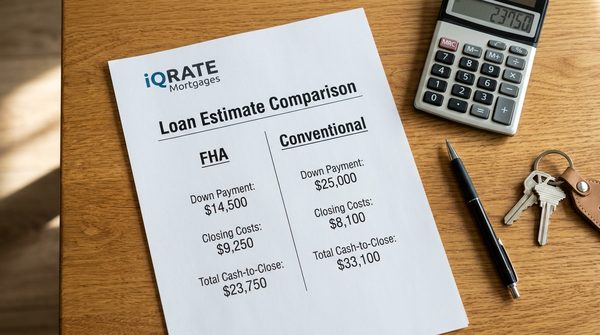
This is the ultimate question. A 3% down payment is less than 3.5%, so the Conventional loan must be cheaper, right? Not necessarily. Let’s create a side-by-side estimate for a $400,000 home purchase in Fresno, California, assuming a 700 credit score.

FHA Loan Estimate (3.5% Down)
- Purchase Price: $400,000
- Down Payment: $14,000 (3.5%)
- Base Loan Amount: $386,000
- Upfront Mortgage Insurance (UFMIP): $6,755 (financed into the loan)
- Total Loan Amount: $392,755
- Estimated Closing Costs & Prepaids: $8,500
- Total Estimated Cash-to-Close: $22,500 ($14,000 + $8,500)
Conventional 97 Loan Estimate (3% Down)
- Purchase Price: $400,000
- Down Payment: $12,000 (3.0%)
- Base Loan Amount: $388,000
- Upfront Mortgage Insurance: $0 (assuming monthly PMI)
- Total Loan Amount: $388,000
- Estimated Closing Costs & Prepaids: $8,500
- Total Estimated Cash-to-Close: $20,500 ($12,000 + $8,500)
At first glance, the Conventional loan requires $2,000 less cash. The lower down payment makes the initial difference.
However, this doesn't account for seller credits.
- With the Conventional loan, the max seller credit is 3%, or $12,000. This could cover your closing costs and prepaids ($8,500), but you'd still need to bring the full $12,000 down payment.
- With the FHA loan, the max seller credit is 6%, or $24,000. A motivated seller could agree to pay a credit covering all of your closing costs and prepaids ($8,500). In that scenario, your cash-to-close would only be your $14,000 down payment.
Your credit score also plays a huge role. The monthly PMI on the Conventional loan will be significantly higher for a borrower with a 640 credit score versus one with a 740 score. FHA's monthly mortgage insurance is less sensitive to credit scores, making it a more predictable option for some borrowers.
Verdict: The 3% down Conventional loan often requires less cash out-of-pocket if no seller credits are involved. But an FHA loan with a significant seller credit can be the cheaper option for getting into a home.
Can Gift Funds Be Used to Cover All My Closing Costs for Both Loans?
Yes, both FHA and Conventional loans allow you to use gift funds from acceptable donors (usually close family members) to help with your cash-to-close. However, the rules have important distinctions.
FHA Gift Funds: FHA guidelines are very flexible. A borrower can use gift funds for the entire amount of their cash-to-close. This means your 3.5% down payment, all closing costs, and all prepaids can be a gift. The donor must provide a signed gift letter stating the funds are not a loan, along with documentation showing the source of the funds.
Conventional Gift Funds: For a Conventional loan on a primary, single-family residence, the entire down payment can come from gift funds, even if you are putting down less than 20%. While agency guidelines permit this, individual lenders may have their own specific requirements, known as overlays, that could ask for a borrower contribution from their own funds. (The data, information, or policy mentioned here may vary over time.)
For buyers in Fresno and Clovis relying entirely on financial help from family, the FHA loan offers a clearer, more universally accepted path to using 100% gift funds for all cash-to-close requirements. The numbers can be complex, and the best loan choice depends entirely on your financial profile, credit score, and the details of your purchase. To get a personalized, side-by-side comparison of FHA and Conventional loans for your situation in Fresno, it's best to consult with a mortgage expert who can provide a detailed Loan Estimate.
Ready to see how these numbers stack up for your home purchase in Fresno? Apply now to get a personalized loan comparison and expert guidance for your specific financial situation.
Author Bio
David Ghazaryan is the expert mortgage strategist and founder behind iQRATE Mortgages. With a mission to fund home loans that traditional banks won't touch, David specializes in helping clients with unique financial situations, including those recovering from foreclosure or bankruptcy. He expertly crafts smart, strategic, and stress-free mortgages by leveraging a vast network of over 100 lenders to secure competitive rates for investors and homebuyers alike. Praised for exceptional customer service, David has helped hundreds of families with a 97% satisfaction rate, guiding them to the mortgage they deserve.









