

The Foreign Investment in Real Property Tax Act (FIRPTA) Explained
For many foreign nationals purchasing property in sought-after areas like Miami, the term FIRPTA often comes as a last-minute surprise. Understanding this federal tax law is not just important; it's critical to avoid significant financial withholdings and closing delays. FIRPTA is not a tax on buying property, but rather a pre-payment of potential capital gains tax when the foreign owner eventually sells the property.
What is FIRPTA?
The Foreign Investment in Real Property Tax Act of 1980 is a United States tax law that imposes a withholding tax on the sale of U.S. real property by foreign persons. When a non-U.S. citizen sells a property, the buyer is generally required to act as the withholding agent. The buyer must withhold 15% of the gross sales price and remit it to the Internal Revenue Service (IRS) within 20 days of the closing. This is to ensure the IRS can collect any capital gains tax owed by the foreign seller.
While this is a seller's tax, it directly impacts your purchase. The title company or closing agent facilitates this process, but as the buyer, you are technically responsible. Failure to withhold can result in you, the buyer, being held liable for the tax.
How FIRPTA Affects Your Miami Home Purchase
When you buy a home in Miami or Doral from a foreign seller, your closing agent will require the seller to sign a FIRPTA affidavit. This is a sworn statement confirming their U.S. or non-foreign tax status. If the seller is a foreign person, the 15% withholding is triggered. The funds are held from the seller's proceeds and sent to the IRS. It is crucial that your purchase agreement correctly identifies the seller's status and includes clauses addressing FIRPTA compliance.
Exemptions and Withholding Reductions
Several exemptions can reduce or eliminate the withholding requirement. The most common one for homebuyers is:
- Personal Residence Exemption: If the sales price is $300,000 or less, and you (the buyer) intend to use the property as your primary residence for at least 50% of the time for the first two years after purchase, the 15% withholding may be waived. (The data, information, or policy mentioned here may vary over time.)
- Reduced Withholding: If the sales price is between $300,001 and $1,000,000, and you intend to use it as a primary residence, the withholding rate is reduced from 15% to 10%. (The data, information, or policy mentioned here may vary over time.)
Sellers can also apply for a 'Withholding Certificate' from the IRS to reduce or eliminate the withholding amount if they can prove the actual tax liability is less than the 15% withheld. This process, however, can take 90 days or more and must be initiated well before closing.
Calculating Closing Costs for a Foreign National Buyer in Miami
Closing costs are the various fees you pay to finalize your real estate transaction. For a foreign national buyer, these costs can be slightly higher than for a domestic buyer due to international complexities. On average, you can expect closing costs in Florida to be between 2% and 5% of the home's purchase price. (The data, information, or policy mentioned here may vary over time.)
Standard Closing Costs
These are the typical fees every buyer in Florida encounters:
- Title Insurance: Protects you and the lender from claims against the property's title. This is a one-time fee paid at closing.
- Documentary Stamp Tax (Doc Stamps): A state and county tax on the deed. In Miami-Dade County, the rate is $0.60 per $100 of property value, plus a surtax of $0.45 per $100 on transactions that are not single-family homes. (The data, information, or policy mentioned here may vary over time.)
- Intangible Tax: A state tax on the mortgage, calculated at a rate of 2 mills ($0.002) on the loan amount. (The data, information, or policy mentioned here may vary over time.)
- Recording Fees: Paid to the county to officially record the deed and mortgage in public records.
- Lender Fees: Includes charges for loan origination, underwriting, and appraisal. (The data, information, or policy mentioned here may vary over time.)
- Prepaids: Costs paid in advance, such as homeowner's insurance premiums and property taxes that go into an escrow account.
Costs Unique to International Buyers
- International Wire Transfer Fees: Both your sending bank and the receiving U.S. bank will likely charge fees. You may also incur a fee from an intermediary bank.
- Currency Conversion Fees: The cost associated with converting your home currency into U.S. dollars. The exchange rate you receive is a critical factor.
- Document Authentication/Courier Fees: If you are signing documents abroad, you may need to pay for apostille services (international certification) and international express shipping.
Example Cost Breakdown for a Doral Property
Let's assume you're purchasing a condominium in Doral for $750,000 with a $500,000 loan:
- Doc Stamps on Deed: [($750,000 / 100) * $0.60] + [($750,000 / 100) * $0.45] = $7,875
- Doc Stamps on Mortgage: ($500,000 / 100) * $0.35 = $1,750
- Intangible Tax on Mortgage: ($500,000 * 0.002) = $1,000
- Owner's Title Insurance (estimate): ~$3,500
- Lender's Title Insurance (estimate): ~$400 (simultaneous issue rate)
- Lender Origination Fee (1% example): $5,000
- Recording Fees (estimate): ~$500
- International Wire/Currency Fees (estimate): ~$200 - $500+
This is a simplified example. Your closing agent will provide a detailed Closing Disclosure form itemizing all final costs.
Structuring International Wire Transfers for Closing
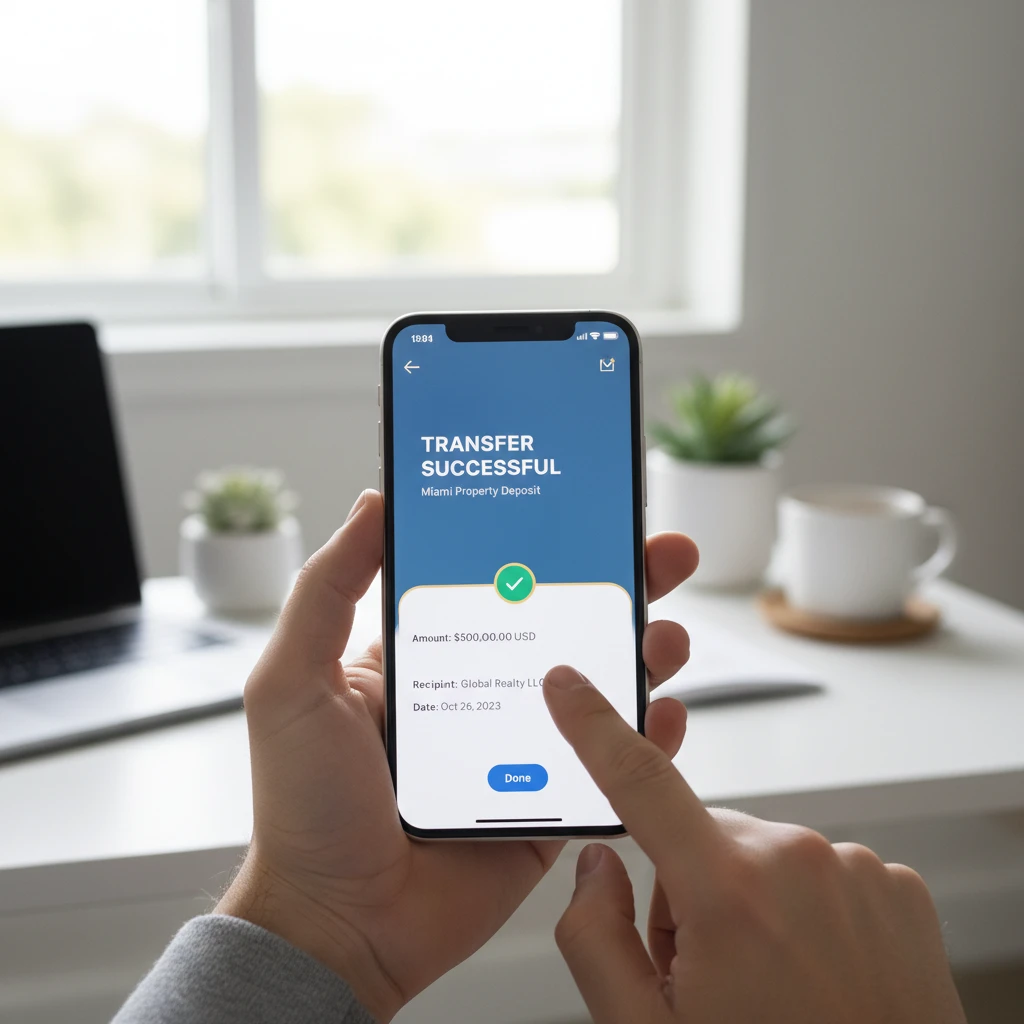
Wiring funds from your home country to the U.S. title company is one of the most delay-prone steps in the closing process for a foreign buyer. U.S. banks operate under strict anti-money laundering (AML) and know-your-customer (KYC) regulations, and international wires are scrutinized heavily.
Step-by-Step Guide to a Successful Wire
- Request Instructions Early: As soon as you have a closing date, request detailed wiring instructions from your title company. Never accept instructions sent via a regular email; always verify them over the phone using a known number to prevent wire fraud.
- Provide Instructions to Your Bank: Give your bank the exact information provided, including the U.S. bank's name, address, ABA routing number, SWIFT/BIC code, the title company's account name and number, and any 'for further credit' or reference information.
- Account for All Fees: Instruct your bank to send the wire so that the full required amount arrives in the title company's account. This often means sending slightly more to cover fees from intermediary banks.
- Initiate the Transfer Early: Do not wait until the day before closing. International wires can take 3-5 business days or longer if they are flagged for review. Send your funds at least one week before your scheduled closing date.
- Confirm Receipt: After sending the wire, get a confirmation receipt from your bank. Follow up with the title company to confirm they have received the funds.

The Role of Title Insurance for International Buyers in Doral
When you are buying property from thousands of miles away, you need absolute certainty about what you are purchasing. Title insurance provides that security. It is a form of indemnity insurance that protects you, the homeowner, from financial loss resulting from defects in the property's title.
Why Title Insurance is Essential for Foreign Nationals
For an international buyer in Doral, an owner's title insurance policy is non-negotiable. It protects you against hidden risks that a title search might not uncover, such as:
- Forgery and Fraud: Someone forging a previous owner's signature on a deed.
- Undisclosed Heirs: A previously unknown heir of a former owner appearing to claim ownership.
- Liens and Encumbrances: Unpaid taxes, contractor liens, or other debts attached to the property by a previous owner.
- Clerical Errors: Mistakes in public records.
Without an owner's policy, you could be responsible for paying off old debts or even lose the property entirely in a legal battle, with little recourse from your home country.
Managing a Remote Closing: Special Signing Requirements
One of the biggest concerns for foreign national buyers is the logistics of signing closing documents. The good news is that you do not have to be physically present in Miami to close on your property. There are several well-established methods for remote closings.
Remote Online Notarization (RON)
Florida is a pioneer in allowing Remote Online Notarization (RON). This technology allows you to appear before a commissioned Florida notary using two-way audio-video technology. You can be anywhere in the world, sign documents electronically, and have them notarized in real-time. This is the fastest and most efficient remote closing method, but you must confirm that your lender and title company are equipped to handle a full RON closing.
Using a Power of Attorney (POA)
A Power of Attorney is a legal document that allows you to designate a trusted person in the U.S. (such as a real estate attorney or family member) to sign the closing documents on your behalf. The POA document must be specific to the real estate transaction and approved in advance by both your mortgage lender and the title company. Creating a valid POA often requires you to sign it in the presence of a notary at a U.S. Embassy or Consulate in your country.
Mail-Away Closings
In a traditional 'mail-away' closing, the title company ships the physical closing package to you via international courier. You then take the documents to a notary, typically at a U.S. Embassy or Consulate, sign them, and mail them back. This is the slowest method and requires careful coordination to ensure documents are returned before the closing deadline.
Typical Closing Timeline for a Non-United States Citizen
While a domestic mortgage can often close in 30-45 days, the timeline for a foreign national loan is typically longer due to the added layers of verification.
- Loan Processing and Underwriting (30-45 days): This is the longest phase. The lender must verify foreign income sources, translate documents, and trace the source of funds for the down payment, which takes more time than with domestic applicants.
- Clear to Close and Final Steps (7-10 days): Once the loan is approved, the closing is scheduled. This is when you must wire your funds and coordinate your signing method.
It is wise to budget 45 to 60 days from the time your purchase contract is accepted until the closing date to avoid stress and potential contract breaches. (The data, information, or policy mentioned here may vary over time.)
Common Issues That Delay Closings for Foreign Nationals
- Funding and Wire Transfer Delays: This is the number one cause of postponed closings. Incorrect information, bank holidays in either country, or compliance reviews can hold up funds for days.
- Documentation and Verification Problems: Lenders may struggle to verify income from a foreign employer or assets held in a foreign institution. Providing clear, translated, and comprehensive documentation upfront is key.
- Power of Attorney (POA) Complications: A POA that is not drafted correctly or that hasn't been pre-approved by the lender and title company will be rejected, halting the closing.
- FIRPTA Misunderstandings: Confusion about FIRPTA withholding can cause last-minute disputes between the buyer and seller, delaying the final signatures. Navigating a mortgage closing in Miami or Doral from another country requires expert guidance. If you have questions about FIRPTA, international fund transfers, or remote signing, a specialized mortgage strategist can provide the clarity you need for a confident and successful home purchase.
Navigating the complexities of a U.S. mortgage from abroad is our specialty. If you're ready to secure financing for your Miami or Doral property, take the next step with confidence and Apply for a Mortgage today.
Author Bio
David Ghazaryan is the expert mortgage strategist and founder behind iQRATE Mortgages. With a mission to fund home loans that traditional banks won't touch, David specializes in helping clients with unique financial situations, including those recovering from foreclosure or bankruptcy. He expertly crafts smart, strategic, and stress-free mortgages by leveraging a vast network of over 100 lenders to secure competitive rates for investors and homebuyers alike. Praised for exceptional customer service, David has helped hundreds of families with a 97% satisfaction rate, guiding them to the mortgage they deserve.
References









