


What Are the Income Qualifications for a USDA Rural Development Loan?
The USDA loan program is specifically designed to help low-to-moderate-income households achieve homeownership. Unlike conventional mortgages that focus solely on the borrower's income, the USDA considers the total household income. This means the gross income of every adult who will be living in the home is counted toward the limit, even if they are not on the loan application.
These income limits are not one-size-fits-all; they vary by county and household size. The goal is to ensure the program serves the intended population in each specific market. For example, the limits in the Orlando metro area will differ from those in more rural parts of Florida.
Let's look at a practical example for Orange County, where Orlando is located:
- Household Size 1-4: The maximum annual household income is typically around $110,650.
- Household Size 5-8: The limit increases to approximately $146,050. (The data, information, or policy mentioned here may vary over time.)
Lenders will also look at two key debt-to-income (DTI) ratios. Generally, your proposed monthly housing payment should not exceed 29% of your gross monthly income, and your total monthly debt payments (including the new mortgage, car loans, credit cards) should not exceed 41% of your gross monthly income. However, with a strong credit score (typically 680+), these ratios may be extended. (The data, information, or policy mentioned here may vary over time.)
Can You Make Deductions from Your Income?
Yes, the USDA program allows for certain deductions from your gross household income, which can help you qualify even if you are slightly over the limit. These allowable deductions include:
- $480 for each child under the age of 18.
- $480 for any household member who is a full-time student or has a disability.
- Verified childcare expenses for children aged 12 or younger.
- $400 for each household member aged 62 or older. (The data, information, or policy mentioned here may vary over time.)
These adjustments can make a significant difference for a family trying to qualify for a home in a desirable suburban community near Sanford or Apopka.
How Can I Find USDA-Eligible Property Areas Near Orlando?
One of the biggest misconceptions about the USDA loan is that it's only for farms or homes in the middle of nowhere. In reality, the term 'rural' is defined broadly by the U.S. Department of Agriculture. Many suburban towns and developing communities just outside major city centers like Orlando are eligible.

The key is that the property must be located in a designated eligible area. Densely populated city centers are generally excluded, but you might be surprised at how close to the city you can be.
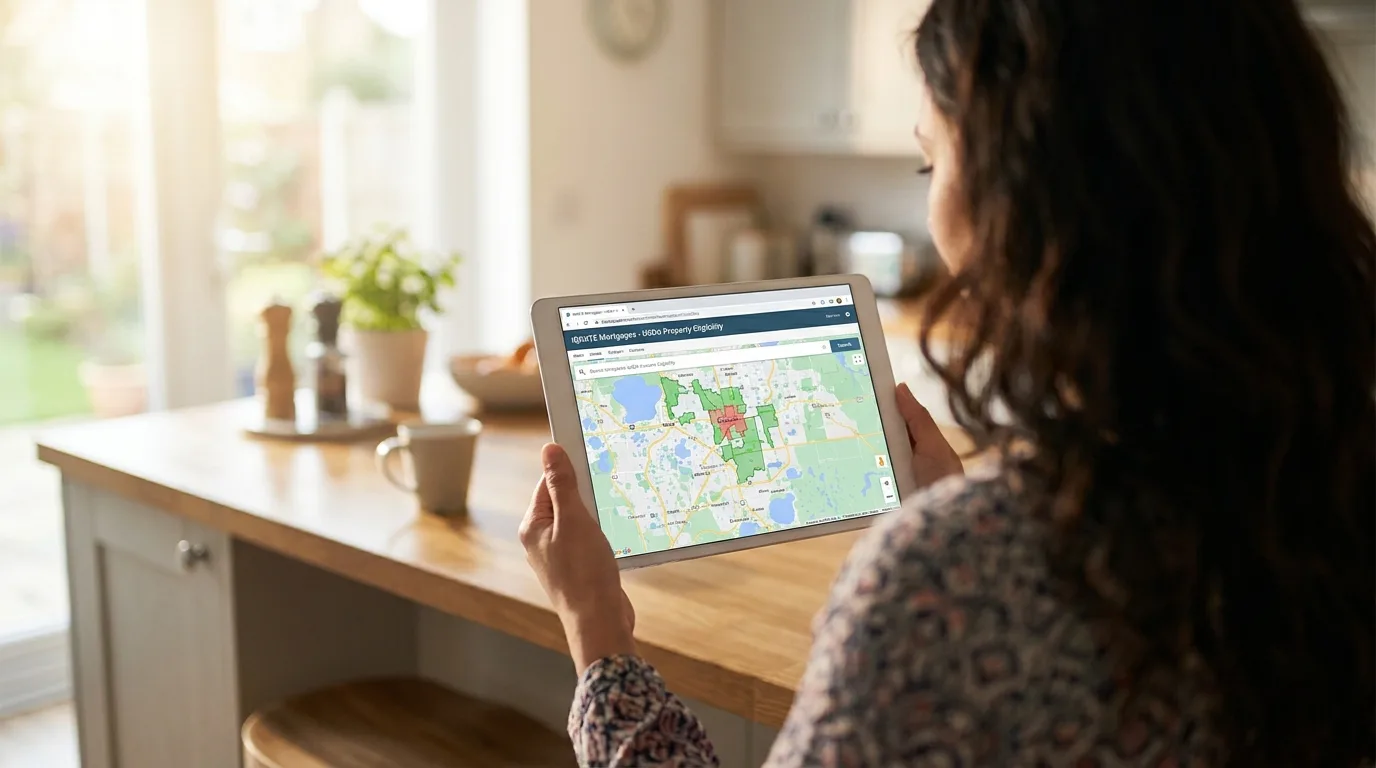
To find out if a specific property qualifies, you must use the official USDA Property Eligibility Map. This is the only tool that can give you a definitive answer. The process is simple:
- Visit the USDA eligibility website.
- Select 'Single Family Housing Guaranteed'.
- Enter the full street address, city, state, and zip code of the property you're interested in.
- The map will instantly display a result, telling you if the address is 'Eligible' or 'Ineligible'.
For homebuyers looking in Central Florida, this means you likely won't find an eligible property in downtown Orlando. However, if you look at communities just a short drive away, your options expand significantly. Areas like Apopka, Winter Garden, Ocoee, and parts of Sanford and Lake County often have large pockets of USDA-eligible neighborhoods. These communities offer a great suburban lifestyle while still providing convenient access to the Orlando metro's amenities and job market.
What Are the Minimum Credit Score Requirements for a USDA Mortgage?
While the USDA does not set a hard minimum credit score, it provides guidelines that lenders use to streamline the approval process. To get the most efficient approval through the USDA's Guaranteed Underwriting System (GUS), most lenders look for a minimum credit score of 640. (The data, information, or policy mentioned here may vary over time.)
A score of 640 or higher generally indicates to the lender that you have a history of managing debt responsibly. This allows the GUS system to automate much of the approval, making the process faster and smoother. Applicants with a 640+ score typically need to meet standard documentation requirements for income and assets.
What If Your Credit Score Is Below 640?
It is still possible to get a USDA loan with a credit score below 640, but the process requires manual underwriting. This is a more hands-on evaluation where an underwriter personally reviews your entire financial profile to assess your creditworthiness. They will look for compensating factors that demonstrate your ability and willingness to repay the loan, such as:
- A stable employment history of at least two years.
- A low debt-to-income ratio.
- Significant savings or cash reserves.
- A consistent history of paying rent on time for the last 12 months, which can sometimes be used as non-traditional credit.
It's important to note that individual lenders can impose their own, stricter credit score requirements, known as 'overlays'. One lender might accept a 620 score for manual underwriting, while another may set their minimum at 660, even for GUS approval.
How Does a USDA Loan Compare to an FHA Loan for a First Home in Sanford?
For a first-time homebuyer in a city like Sanford, both USDA and FHA loans are excellent options. However, they have key differences that can make one a better fit for your situation.
Comparing Down Payment and Property Location Rules
- USDA Loan: Requires 0% down. This is its single biggest advantage. However, the property must be in a USDA-eligible area.
- FHA Loan: Requires a minimum 3.5% down payment. Its major advantage is that it can be used to purchase a property anywhere, with no geographic restrictions.
A Look at Monthly Mortgage Insurance
Both loan types require mortgage insurance, but it's structured differently. Let's compare using a $350,000 home purchase in Sanford.
- USDA Guarantee Fee:
- Upfront Fee: 1.0% of the loan amount ($3,500), which can be rolled into the mortgage.
- Annual Fee: 0.35% of the outstanding principal balance, paid monthly. This equates to about $102 per month in the first year.
- FHA Mortgage Insurance Premium (MIP):
- Upfront Premium (UFMIP): 1.75% of the loan amount ($6,125), which is typically financed into the loan.
- Annual Premium: 0.55% (for most borrowers with 3.5% down), which equates to about $158 per month. With an FHA loan, this premium usually lasts for the entire life of the loan. (The data, information, or policy mentioned here may vary over time.)
For the same home, the USDA loan has a significantly lower monthly mortgage insurance cost.
How Income Rules Differ
- USDA Loan: Has strict household income limits, as discussed earlier.
- FHA Loan: Has no income limits, making it accessible to high-income earners.
For a buyer in Sanford who finds an eligible property and meets the income criteria, the USDA loan's zero down payment and lower monthly costs are hard to beat. If the ideal home is in an ineligible area or the household income is too high, the FHA loan is a fantastic alternative.
What Is the USDA Guarantee Fee and How Does It Work?
The USDA Guarantee Fee is the program's form of mortgage insurance. It protects lenders against loss if a borrower defaults on the loan. This guarantee is what makes it possible for lenders to offer 100% financing with competitive interest rates. The fee is split into two parts.
The One-Time Upfront Fee
This is a one-time fee calculated as 1.0% of the total loan amount. One of the best features of the USDA loan is that this fee does not have to be paid in cash at closing. Instead, it can be financed by adding it to your total loan balance.
- Example: You are approved for a $300,000 home loan in an eligible area near Orlando.
- The upfront guarantee fee is 1.0% of $300,000, which is $3,000.
- Your final loan amount will be $303,000 ($300,000 + $3,000).
This feature helps keep your out-of-pocket closing costs as low as possible.
The Ongoing Annual Fee
This is a recurring fee that is paid monthly as part of your total mortgage payment. It is calculated as 0.35% of the average outstanding principal balance for the year. Because the fee is based on the remaining balance, the dollar amount you pay each year decreases slightly as you pay down your loan. (The data, information, or policy mentioned here may vary over time.)
This annual fee is significantly lower than the MIP on an FHA loan, which contributes to the USDA loan's affordability over the long term.
Can I Finance My Closing Costs Into a USDA Home Loan?
Yes, under specific circumstances, a USDA loan allows you to finance your closing costs. This is another powerful feature that minimizes the cash you need to bring to closing. However, this is only possible if the home's appraised value is higher than the seller's purchase price.
The lender will allow you to borrow up to the appraised value. This extra room can be used to cover your closing costs, the upfront guarantee fee, or both.
Let's look at an example:
- Purchase Price: $320,000
- Your Estimated Closing Costs: $6,000
- The Home Appraises For: $328,000
In this scenario, the appraised value is $8,000 higher than the purchase price. You have enough room to finance the entire $6,000 in closing costs into the loan. Your new loan amount would be $326,000 ($320,000 purchase price + $6,000 closing costs), plus the financed upfront guarantee fee.
If the home appraises at the purchase price, you cannot finance closing costs and will need to cover them using other methods, such as seller concessions (where the seller agrees to pay up to 6% of the sale price towards your costs) or your own funds.
What Types of Property Inspections Are Required for USDA Loans?
The USDA requires that any home financed through its program meets its Minimum Property Requirements. The property must be safe, structurally sound, and sanitary. This is verified by a state-licensed appraiser during the appraisal process.
While a full home inspection is highly recommended for the buyer's own protection, it is not technically required by the USDA. The appraisal is the key evaluation for the lender. The appraiser will check for any issues that could compromise the home's livability or value. Common red flags include:
- Safety Hazards: Faulty electrical systems, broken stairs or handrails, non-functional smoke detectors.
- Structural Soundness: Evidence of foundation cracks, a leaky roof, or significant water damage.
- Sanitary Conditions: A functioning and safe water supply and wastewater disposal system are mandatory.
- General Condition: Widespread peeling or chipping paint (especially on homes built before 1978 due to lead paint risks), inadequate heating and cooling systems, or broken windows.
If the appraiser notes any of these deficiencies, they must be repaired and re-inspected before the loan can be finalized. In some cases, a specialized inspection, such as a pest inspection, may also be required if the appraiser notes evidence of wood-destroying insects. The path to a zero-down home loan in Florida might be clearer than you think. If you're exploring options around Orlando or Sanford, understanding your eligibility for a USDA loan is a crucial first step. Connect with a mortgage expert to review your specific income situation and start identifying eligible properties today.
Ready to take the next step toward homeownership with a zero-down payment loan? Our mortgage experts can help you navigate the USDA loan process with confidence. Apply now to find out if you qualify.
Author Bio
David Ghazaryan is the expert mortgage strategist and founder behind iQRATE Mortgages. With a mission to fund home loans that traditional banks won't touch, David specializes in helping clients with unique financial situations, including those recovering from foreclosure or bankruptcy. He expertly crafts smart, strategic, and stress-free mortgages by leveraging a vast network of over 100 lenders to secure competitive rates for investors and homebuyers alike. Praised for exceptional customer service, David has helped hundreds of families with a 97% satisfaction rate, guiding them to the mortgage they deserve.
References
USDA Single Family Housing Guaranteed Loan Program








