


Third-Party Verification Services for Foreign Businesses
When you apply for a jumbo loan in Miami using income from a foreign business, lenders cannot simply take your documents at face value. They have a fiduciary duty to verify every detail, which is why they rely on specialized third-party verification (TPV) services. These firms act as impartial investigators, providing an objective assessment of your overseas operations. This step is critical for mitigating risk and preventing fraud.
These services go far beyond a simple Google search. They perform deep-dive checks that may include:
- Business Registration and Licensing: The TPV firm will confirm that your company is legally registered and in good standing with the governing authorities in its home country.
- Operational Verification: They may use local agents or databases to confirm your business has a physical address, is actively operating, and is not just a shell corporation.
- Revenue and Financial Health: Some services can cross-reference financial data with public records or industry databases to add a layer of validation to the income you've declared.
For example, if a prospective buyer from Colombia wants a jumbo mortgage for a luxury condo in Naples, the lender might engage a TPV service to validate their Bogota-based manufacturing company. The service would provide a comprehensive report confirming the company’s incorporation date, its operational status, and any public financial records, giving the underwriter confidence in the income source.
Document Translation and Certification for Miami Mortgages
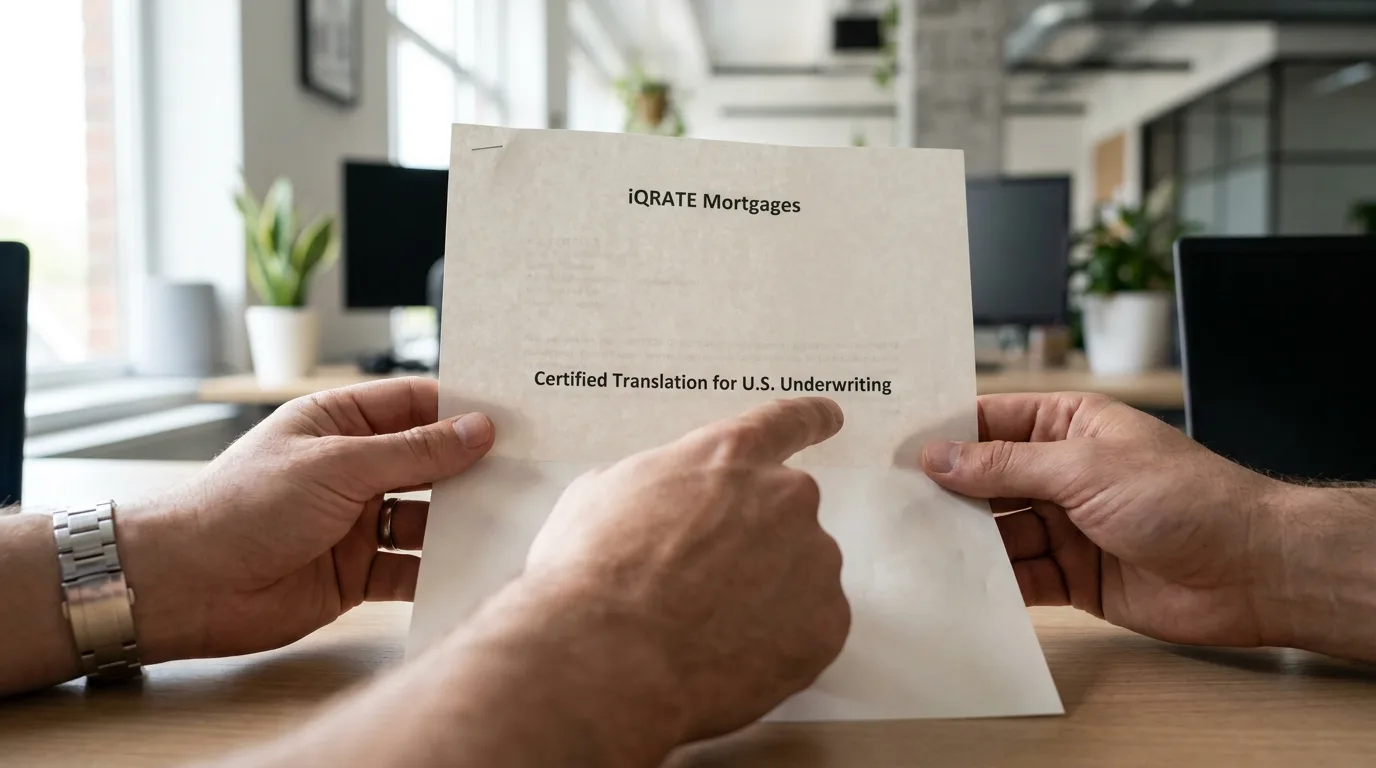
One of the most common stumbling blocks for international buyers is improper documentation. Every single financial document that is not in English must be translated by a professional, independent third party. You, your family members, or your business associates cannot perform the translation, as this creates a conflict of interest.
A certified translation is the industry standard. This means the translator or translation company provides a signed statement attesting to the accuracy and completeness of the translation. This certification is attached to both the original document and the translated version.
Documents that typically require certified translation include:
- Personal and business tax returns
- Bank statements for all accounts, especially those used for the down payment
- Employment contracts or letters of employment
- Business registration documents and licenses
- Profit and loss statements
- Foreign credit reports

Submitting documents without proper translation will lead to immediate delays or even a denial of your loan application. Lenders in competitive markets like Miami and Naples have strict protocols and will not make exceptions to this rule.
Lender Analysis of Foreign Business Tax Returns
Analyzing foreign tax returns is a complex task because tax laws, accounting principles, and reporting standards vary dramatically from country to country. U.S. underwriters are trained to 'normalize' this information, converting it into a format that aligns with American lending standards, similar to how they analyze a self-employed U.S. borrower's tax returns.
Reconciling Income with U.S. Standards
The lender's goal is to determine your stable, recurring monthly income. They are not interested in one-time windfalls, capital gains from selling an asset, or unverified income. They will dissect your foreign tax returns to identify consistent business profits. For instance, income reported under a German or British tax system will be adjusted to find a figure comparable to what would appear on a U.S. IRS Schedule C (for a sole proprietorship) or Form 1120-S (for a corporation). They will typically average the income over the most recent two to three years to ensure it is stable and likely to continue.
Calculating Qualifying Income
Just like with U.S.-based business owners, lenders often 'add back' certain non-cash expenses to get a clearer picture of your actual cash flow. The most common add-back is depreciation. If your foreign business tax return shows a net profit of €300,000 after claiming €50,000 in depreciation on equipment, a U.S. underwriter may add that €50,000 back, calculating your qualifying income based on €350,000. They are looking for your true ability to repay the loan, which is based on cash flow, not just taxable profit.
Using an Accountant's Letter to Prove Income
A common misconception is that a letter from a home-country accountant or Chartered Professional Accountant (CPA) can replace official tax documents. This is incorrect. An accountant's letter is a supplementary document, not a primary one. While valuable, it serves to clarify and support the primary evidence—your tax returns and bank statements.
A well-written accountant's letter can significantly help your case. It should:
- Be on official company letterhead with the accountant's license number and contact information.
- State the name of the business and your ownership percentage.
- Confirm the business's start date and that the accountant has prepared its financials for a specified period (e.g., the last three years).
- Provide a clear, year-by-year breakdown of your income derived from the business.
- Briefly explain any unusual circumstances or complex local tax laws that might be confusing to a U.S. underwriter.
This letter adds a layer of professional validation and can help bridge the gap between foreign and U.S. accounting practices, but it will never be accepted as the sole proof of income for a Miami jumbo loan.
Sourcing Rules for Down Payments from Foreign Accounts
Lenders are legally required to verify the source of all funds used in a real estate transaction, especially the down payment. This is done to comply with anti-money laundering (AML) regulations and to ensure the funds are not from an unapproved loan. When your down payment comes from a foreign account, the scrutiny is even higher.
Proving a Legitimate Paper Trail
The funds for your down payment and closing costs must be properly 'seasoned'. This means the money must have been in your account for a certain period, typically 60 to 90 days (or two to three full bank statement cycles). (The data, information, or policy mentioned here may vary over time.) A large, recent deposit that cannot be explained will raise a major red flag. You must provide a clear paper trail showing exactly where the money came from. For example, if you sold stocks to generate the funds, you'll need to provide the brokerage statements showing the sale and the subsequent transfer into your bank account.
International Wire Transfer Documentation
When you move the funds from your foreign account to a U.S. bank account, you must document the transfer meticulously. For a significant down payment on a Naples property, you will be required to provide:
- A copy of the wire transfer receipt from the sending (foreign) bank.
- A bank statement from the foreign account showing the funds leaving.
- A bank statement from the U.S. account showing the funds arriving.
If the names on the accounts do not match perfectly or the transfer is complex, you will also need to write a detailed letter of explanation to the underwriter.
How Currency Exchange Rates Affect Income Qualification in Naples
Income earned in a foreign currency introduces a layer of volatility that lenders must account for. The exchange rate between the U.S. dollar and another currency can fluctuate daily, impacting the actual value of your income. To manage this risk, lenders will not use the exchange rate on the day you apply.
Instead, they typically average the exchange rate over a longer period, such as the past 12 or 24 months, to establish a more stable baseline. Furthermore, many lenders will apply a 'haircut' or discount to your foreign income. This means they might only count 75% to 90% of the calculated U.S. dollar equivalent for qualification purposes. (The data, information, or policy mentioned here may vary over time.) This buffer protects the lender in case your home country's currency devalues against the dollar, which would make your mortgage payment more expensive for you and increase the risk of default.
For example, if your income from a UK-based business is £200,000 annually and the average exchange rate is 1.25, your USD equivalent is $250,000. A lender applying a 20% haircut would only use $200,000 of that income for calculating your debt-to-income ratio.
Consideration of Foreign Credit History for Home Loans
Your credit history in your home country does not directly transfer to the United States. U.S. lenders rely on the FICO credit scoring system, which is based on your credit activity with U.S.-based creditors. If you have no U.S. credit history, you will be considered to have no score, which can be a significant hurdle for traditional mortgages.
Building U.S. Credit or Providing Alternatives
For jumbo loans, some lenders have more flexibility. While a strong FICO score is always preferred, some may be willing to build a non-traditional credit profile for you. This involves providing alternative evidence of your creditworthiness. You may be asked to provide:
- At least 12 months of verification of rent payments from your current landlord.
- Proof of timely utility payments (electricity, gas, water) for the past 12 months.
- Letters of reference from financial institutions or creditors in your home country.
A foreign credit report can be a helpful supplementary document, but it is not a substitute for a U.S. credit history. The best approach for international buyers is to begin establishing a U.S. credit file as soon as possible by opening a U.S. bank account and obtaining a secured credit card. Navigating the verification of foreign income requires expert guidance. If you're planning to buy in Miami or Naples, partnering with a mortgage strategist who understands these complex international requirements can ensure a smooth and successful jumbo loan approval.
Understanding the nuances of foreign income verification is crucial for securing a jumbo loan in Miami or Naples. If you're ready to navigate this process with an expert guide, Apply now to start your journey.
Author Bio
David Ghazaryan is the expert mortgage strategist and founder behind iQRATE Mortgages. With a mission to fund home loans that traditional banks won't touch, David specializes in helping clients with unique financial situations, including those recovering from foreclosure or bankruptcy. He expertly crafts smart, strategic, and stress-free mortgages by leveraging a vast network of over 100 lenders to secure competitive rates for investors and homebuyers alike. Praised for exceptional customer service, David has helped hundreds of families with a 97% satisfaction rate, guiding them to the mortgage they deserve.
References
Fannie Mae Selling Guide: Foreign Income
Consumer Financial Protection Bureau: Mortgage Application Documents









