

What is the Standard VA Loan Occupancy Requirement?
The U.S. Department of Veterans Affairs guarantees home loans to help service members, veterans, and eligible surviving spouses become homeowners. A core condition of this benefit is the occupancy requirement. The rule states that the veteran borrower must have the intent to personally occupy the property as their primary residence. This isn't just a suggestion; it's a foundational rule of the VA loan program.
Typically, the VA requires the borrower to move into the home within a 'reasonable time', which is generally defined as 60 days from the date of closing. This guideline prevents the misuse of the VA loan benefit for purchasing investment properties or vacation homes, which are not permitted uses for this type of financing. The spirit of the program is to promote homeownership for veterans and their families, not to facilitate real estate investing.
When you sign your VA loan documents, you are certifying your intent to live in the home. Lenders will verify this intent throughout the underwriting process. They need to ensure the loan complies with VA guidelines to secure the government guarantee that backs the mortgage. Failing to meet this requirement can lead to serious consequences, including the possibility of the loan being called due.
How the Spousal Exception Works for a San Diego PCS
For active-duty service members, the logistics of a Permanent Change of Station (PCS) often conflict with the 60-day occupancy rule. You might receive orders to Naval Base San Diego but be on a deployment that won't end for another four months. This is where a critical and helpful exception comes into play.
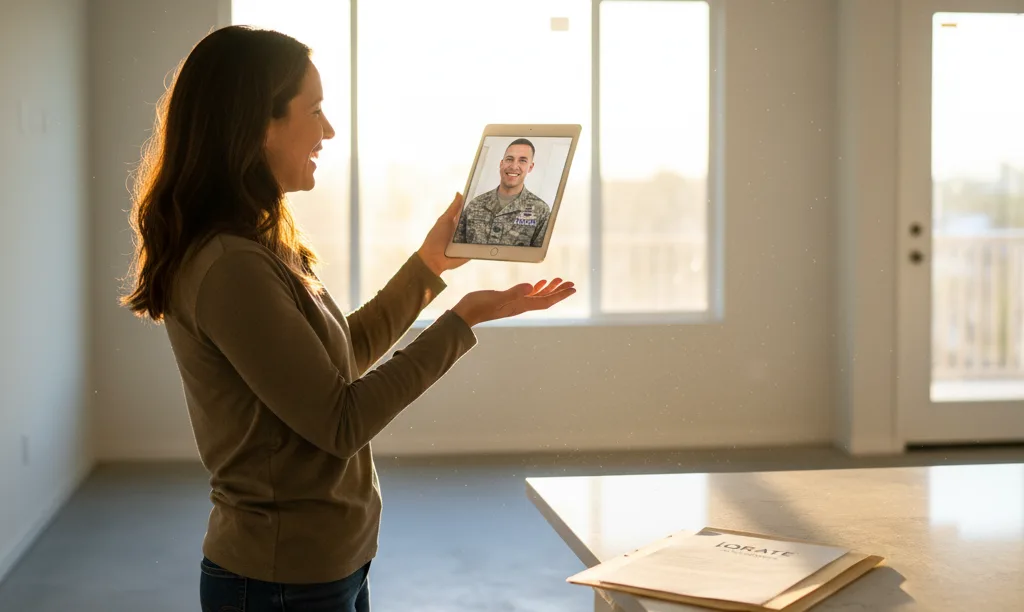
The VA recognizes the unique challenges of military life. Therefore, for an active-duty service member who cannot occupy the home within a reasonable time due to military service, their spouse can satisfy the occupancy requirement on their behalf. This is a powerful provision that allows military families to secure housing in their new location without delay.

Here’s a practical example: You are stationed overseas and receive PCS orders to Camp Pendleton, located near Oceanside. Your report date is 90 days away, but your family wants to move sooner to get your children enrolled in school and settle in. Using this exception, your spouse can travel to Oceanside, find a home, and close on it using your VA loan benefit. As long as your spouse moves into the property within 60 days of closing and lives there as their primary residence, you have successfully met the VA occupancy requirement, even if you won't arrive for several months.
Required Documents to Prove Spousal Occupancy
To use the spousal occupancy exception, you can't simply tell your lender that's the plan. You must provide clear documentation that the underwriter can use to verify your eligibility and your spouse's intent. Being organized with these documents is key to a smooth approval process.
Your PCS Orders
This is the most critical piece of evidence. Your official military orders must clearly state your new duty station. For a home purchase in San Diego, the orders need to show a transfer to a local base, such as Marine Corps Air Station Miramar or Naval Base Coronado. The orders serve as definitive proof that you are an active-duty service member with a legitimate reason for not occupying the property immediately.
Spouse's Statement of Intent
While not always mandatory, it is a best practice and often requested by underwriters. (The data, information, or policy mentioned here may vary over time.) This is a simple, signed letter from your spouse stating their name, the address of the new property, and a clear declaration that they intend to occupy the home as their primary residence within 60 days of closing. This formalizes the intent and adds a layer of assurance for the lender.
Proof of Relationship
The lender will need to verify the legal relationship between you and the person satisfying occupancy. You will be required to provide a copy of your official marriage certificate. This proves that the occupying person is your legal spouse, as defined by VA guidelines.
Does My Spouse Need to Be on the VA Home Loan?
This is a common point of confusion. For the purpose of satisfying the occupancy rule, your spouse does not need to be a co-borrower on the loan. Their physical presence in the home is what fulfills the requirement. However, whether to include them on the mortgage application is a separate strategic decision with its own set of pros and cons.

Pros of Adding Your Spouse to the Loan:
- Increased Income: If your spouse works, their income can be used to help you qualify for the loan. This can be particularly helpful in high-cost areas like San Diego, where home prices are steep. For instance, if your income alone qualifies you for a $650,000 loan but you need to reach $750,000, adding your spouse's $60,000 annual salary could bridge that gap.
- Shared Responsibility: Having both names on the mortgage creates a shared legal and financial responsibility for the property.
Cons of Adding Your Spouse to the Loan:
- Credit Scrutiny: The lender will pull credit reports for both of you. If your spouse has a lower credit score or negative items on their report, it could result in a higher interest rate or even a loan denial. Lenders typically use the lower of the two middle scores for qualifying.
- Debt-to-Income (DTI) Impact: The lender must also consider your spouse's debts, such as car loans, student loans, or credit card balances. If their debt load is high, it could negatively impact your DTI ratio and reduce your borrowing power.
- VA Funding Fee: If your spouse is a non-veteran, adding them to the loan will not change the VA Funding Fee. The fee is based on the veteran's status, down payment amount, and prior use of the VA loan benefit.
Can My Children Satisfy the VA Occupancy Requirement?
The answer to this is an unequivocal no. According to VA guidelines, only the veteran or their legal spouse can satisfy the personal occupancy requirement. A minor child, even living in the home with a legal guardian (like a grandparent), cannot fulfill this obligation on behalf of the service member.
This rule is strict. The VA's intention is to ensure that the benefit is used by the veteran or their immediate family unit, defined specifically as the spouse. If you are a single service member, you cannot have a parent, sibling, or child occupy the home to meet the rule. You must intend to occupy it yourself within the 60-day window, unless you are on active duty and unable to do so, in which case different rules around a later occupancy date may apply, but must be clearly documented.
What Happens if My Spouse Moves Out After a Few Months?
The cornerstone of the occupancy rule is the intent at the time of closing. The VA and the lender underwrite the loan based on the certified promise that the spouse will move in and use the home as their primary residence. Life is unpredictable, and circumstances can change.
If your spouse moves into the Oceanside home in good faith and lives there for several months, but then has to move due to an unforeseen event—such as a family emergency or a job transfer of their own—you are generally not in violation of your loan terms. The key is that the initial occupancy was genuine.
However, this flexibility should not be mistaken for a loophole. If there was a premeditated plan for your spouse to occupy the home for only a short period to satisfy the rule before turning it into a rental property, this would be considered mortgage fraud. The VA takes fraudulent use of its benefits very seriously. Always ensure your actions are based on your genuine intent at the time you close on the home.
Explaining Your Occupancy Plan to the Lender
Transparency is your best asset when using the spousal occupancy exception. Do not wait until the middle of the underwriting process to mention your situation. Inform your loan officer from the very first conversation.
An experienced VA lender will not be surprised by this scenario; they handle it regularly, especially in military-heavy communities like San Diego and Oceanside. Being upfront allows them to set correct expectations and request the right documents from the start. Clearly communicate the following points:
- You are an active-duty service member.
- You have official PCS orders to a local base.
- You will be unable to occupy the property within 60 days due to your military duties.
- Your spouse will be moving into the home to satisfy the VA occupancy requirement.
Providing this information early prevents last-minute underwriting issues and demonstrates that you are acting in good faith. A loan officer who seems confused or unsure about this rule may not have the VA loan experience you need, and it might be wise to seek a specialist.
Using a Power of Attorney to Close on Your San Diego Home
If you are deployed or otherwise unavailable to attend the closing in person, you will need to grant someone Power of Attorney (POA) to sign the legal documents on your behalf. This is almost always your spouse in this scenario.
It is crucial to understand that not all POAs are created equal. Lenders and title companies have very strict requirements. (The data, information, or policy mentioned here may vary over time.)
- Specific Power of Attorney: This is the preferred, and often required, type. A Specific POA (also called a Limited POA) grants authority for a single, specific transaction—in this case, the purchase of a particular property. It will list the property address, loan details, and the exact powers being granted. Because it is narrowly defined, it protects all parties and is readily accepted by title companies.
- General Power of Attorney: This grants broad powers to your designated agent to act on your behalf in almost any financial or legal matter. Lenders and title companies are often hesitant to accept General POAs because they are broad and carry more risk. (The data, information, or policy mentioned here may vary over time.)
Before you have a POA drafted, you must ask the lender and the title company for their specific requirements. They may even provide a template that they want you to use. Get the draft approved by them before it is signed and notarized. This simple step can save you from a major closing delay. Navigating a PCS move and a home purchase at the same time is complex. If you have questions about your specific situation or need to get pre-approved for a VA loan in California, working with a mortgage expert who understands military life is crucial. Reach out to a specialist to ensure your homebuying process is smooth and successful.
A PCS move combined with buying a home can be overwhelming. If you're ready to navigate the VA loan process with an expert who understands the needs of military families, take the first step and apply now for a streamlined pre-approval.
Author Bio
David Ghazaryan is the expert mortgage strategist and founder behind iQRATE Mortgages. With a mission to fund home loans that traditional banks won't touch, David specializes in helping clients with unique financial situations, including those recovering from foreclosure or bankruptcy. He expertly crafts smart, strategic, and stress-free mortgages by leveraging a vast network of over 100 lenders to secure competitive rates for investors and homebuyers alike. Praised for exceptional customer service, David has helped hundreds of families with a 97% satisfaction rate, guiding them to the mortgage they deserve.
References
VA Loan Eligibility Requirements For Homebuyers And Homeowners









