


Decoding Your Loan Estimate: Origination vs. Third-Party Fees
When you receive a Loan Estimate, the first section you'll encounter is 'Loan Costs', broken down into subsections. It’s critical to understand the difference between 'A. Origination Charges' and 'B. Services You Cannot Shop For'. One is the lender's direct profit; the other is a pass-through cost for essential services.
Lender Origination Charges (Section A)
These are what the lender charges for creating and processing your loan. Think of this as the lender's fee for their work. These costs can include:
- Application Fee: A charge for processing your initial mortgage application.
- Underwriting Fee: The cost for the lender's underwriting department to verify your financial information and assess the risk of lending to you.
- Processing Fee: Covers the administrative work of collecting documentation and preparing your loan file for closing.
- Discount Points: An optional fee you can pay to lower your interest rate. We'll explore this in detail later.
These are the most negotiable fees on the Loan Estimate. Because this is the lender's direct compensation, you have the most leverage here. For a $450,000 home loan in Houston, these charges can range from 0.5% to 1% of the loan amount, or $2,250 to $4,500. (The data, information, or policy mentioned here may vary over time.)
Third-Party Services You Cannot Shop For (Section B)
This section includes fees for required third-party services that the lender chooses. You are required to use their selected vendors. These are pass-through costs, meaning the lender doesn't profit from them. Common examples include:
- Appraisal Fee: A licensed appraiser must determine the home's market value to ensure it's worth the price you're paying. This protects the lender's investment.
- Credit Report Fee: The cost to pull your credit history and scores from the major credit bureaus.
- Flood Certification Fee: Determines if the property is in a flood zone, which would require you to purchase flood insurance.
- Tax Service Fee: A one-time fee to a third party to monitor your property tax payments throughout the life of the loan.
While you can't shop for these providers, you can still question the costs if they seem unusually high compared to industry standards in the Katy area.

Understanding Prepaid Expenses in Texas
One of the most confusing parts of closing costs for first-time buyers is the concept of 'prepaids'. These aren't fees; they are your own money being set aside to cover future expenses related to homeownership. The lender requires you to pay these items in advance to establish an escrow account.
Why Prepay Property Taxes and Homeowners Insurance?
An escrow account (or impound account) is a savings account managed by your mortgage servicer. A portion of your monthly mortgage payment goes into this account, and the servicer uses the funds to pay your property taxes and homeowners insurance premiums on your behalf when they come due. This ensures these critical bills are always paid on time, protecting both you and the lender.
At closing, you must fund this account with an initial cushion. Here's what that involves:
- Homeowners Insurance: You will be required to pay for the first full year's insurance premium upfront at or before closing. Additionally, the lender will typically collect two to three months of premium payments to put into your escrow account as a buffer.
- Property Taxes: Property tax collection in Texas can be complex. In Harris County or Fort Bend County, taxes are paid in arrears. This means the bill you receive at the end of the year covers that entire year. At closing, you will need to pay for any property taxes due from the closing date through the end of the current tax period, plus a buffer of several months for the escrow account. The seller will credit you for the portion of the year they owned the property.
For example, if you close on a home in Sugar Land on October 1, the seller is responsible for taxes from January 1 to September 30. You are responsible for October 1 to December 31. You will prepay your portion at closing, and the lender will collect an additional cushion (e.g., three months' worth of taxes) for the escrow account to ensure there's enough to pay the full bill when it's due.
Title and Escrow Service Fees in Houston Explained
Section C of your Loan Estimate, 'Services You Can Shop For', primarily consists of title and settlement fees. While the form says you can shop for these, in Texas, the title insurance rates are set by the state, so there's no price shopping there. However, you can compare settlement or escrow fees between different title companies.
Here’s what these services cover:
- Title Search: The title company searches public records to ensure there are no ownership disputes, liens, or other claims against the property.
- Lender's Title Insurance: This is a mandatory policy that protects the lender against any future claims on the property's title. Its cost is based on the loan amount.
- Owner's Title Insurance: This is an optional but highly recommended policy that protects you, the homebuyer. It's a one-time fee paid at closing that defends your ownership rights for as long as you own the home. In Texas, it's customary for the seller to pay for the owner's policy.
- Escrow or Settlement Fee: This fee is paid to the title company or closing agent for acting as a neutral third party. They handle the transfer of funds, coordinate the signing of all documents, and ensure the new deed is recorded properly with the county.
In the Houston metro area, these collective title and settlement fees can amount to several thousand dollars, depending on the home's purchase price.
Loan Estimate Accuracy: What Can Change Before Closing?
Your Loan Estimate is just that: an estimate. However, federal law regulates how much these estimated costs can change by the time you receive your final Closing Disclosure. The fees are grouped into three categories of tolerance:
- Zero Tolerance: These costs cannot increase at all from the Loan Estimate to the Closing Disclosure. This includes lender origination charges, application fees, and transfer taxes. If the lender quotes you a $995 underwriting fee, it must be $995 at closing.
- 10% Cumulative Tolerance: This category includes fees for services where the lender requires you to use a specific third-party provider, such as the appraisal company or title company. The total sum of these fees cannot increase by more than 10% from your estimate.
- Unlimited Tolerance (No Limit): Costs in this category can change by any amount. This applies to services you shop for yourself (like homeowners insurance or an independent title company), prepaid interest, and initial escrow deposits. The escrow amount can change if property tax rates or insurance premiums are adjusted before closing.
Negotiating Closing Costs on Your Sugar Land Home Loan
Knowing what you can and cannot negotiate is key to saving money. As mentioned, your best opportunity lies in the lender's direct fees.
- Negotiable: Focus on Section A: Origination Charges. You can ask lenders to waive or reduce application, processing, or underwriting fees, especially if you have a strong credit profile or are comparing offers from multiple lenders. You can also negotiate for lender credits, where the lender covers a portion of your closing costs in exchange for you accepting a slightly higher interest rate.
- Non-Negotiable: You generally cannot negotiate third-party fees (appraisal, credit report), government recording charges, or transfer taxes. Prepaid items like property taxes and homeowners insurance premiums are also set by the county and your insurance provider, respectively. Title insurance rates in Texas are regulated by the state and are not negotiable.
Are Discount Points Worth the Upfront Cost?
Discount points are a form of prepaid interest. One point costs 1% of your total loan amount and typically lowers your interest rate by about 0.25%. (The data, information, or policy mentioned here may vary over time.) Whether they are worth it depends entirely on your financial situation and how long you plan to stay in the home.
Let's run a scenario for a $400,000 loan in Katy:
- Option 1 (No Points): 7.0% interest rate. Principal & Interest Payment = $2,661
- Option 2 (1 Point): Cost = $4,000 (1% of $400k). 6.75% interest rate. Principal & Interest Payment = $2,594
Your monthly savings would be $67. To find your break-even point, divide the cost of the point by your monthly savings:
$4,000 / $67 per month = 59.7 months (or about 5 years)
If you are certain you will stay in the home for more than five years, buying the point is a good financial decision. If you plan to move or refinance before then, you would lose money on the transaction.
Calculating Your Final 'Cash to Close'
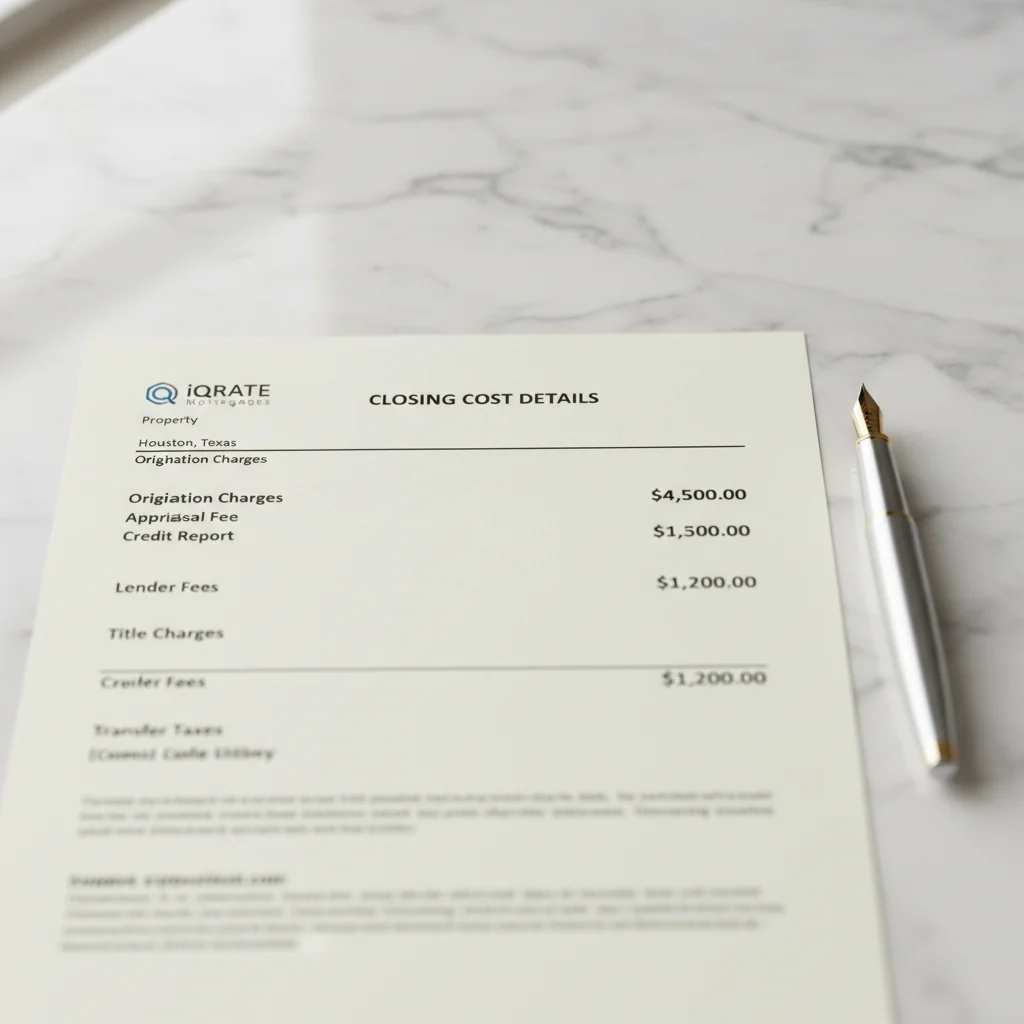
'Cash to Close' is the total amount of money you need to bring to the closing table. It is not the same as your closing costs. It's a final calculation that includes your down payment and credits.
The formula is:
Down Payment + Total Closing Costs – Credits (Earnest Money, Seller/Lender Credits) = Estimated Cash to Close
Here’s a simple example for a $350,000 home in Houston:
- Down Payment (10%): $35,000
- Total Closing Costs: $9,500
- Earnest Money Deposit (already paid): -$3,500
- Seller Credit (negotiated): -$5,000
Calculation: $35,000 + $9,500 - $3,500 - $5,000 = $36,000
Your estimated cash to close would be $36,000.
Where to Find Total Closing Costs on Your Official Form
Finding the key figures on the three-page Loan Estimate is straightforward once you know where to look. Your two most important numbers are 'Total Closing Costs' and 'Estimated Cash to Close'.
- Total Closing Costs: Go to Page 2. Look at the bottom of the 'Loan Costs' and 'Other Costs' table. You will see a line item labeled 'D. Total Closing Costs'. This is the sum of all the fees and prepaids detailed above it.
- Estimated Cash to Close: This is the bottom-line figure. You'll find it on Page 2 at the very bottom, inside the 'Calculating Cash to Close' table. This number tells you exactly how much money you need to have ready for your closing day. Understanding your Loan Estimate is the first step to a smooth closing. If you have questions about your specific costs or want a second opinion on a quote for a Texas home, a mortgage strategist can provide clarity and help you find opportunities to save.
Now that you can decode your Loan Estimate, take the next step towards homeownership with confidence. Apply now to get a clear, competitive quote tailored to your situation and start your journey.
Author Bio
David Ghazaryan is the expert mortgage strategist and founder behind iQRATE Mortgages. With a mission to fund home loans that traditional banks won't touch, David specializes in helping clients with unique financial situations, including those recovering from foreclosure or bankruptcy. He expertly crafts smart, strategic, and stress-free mortgages by leveraging a vast network of over 100 lenders to secure competitive rates for investors and homebuyers alike. Praised for exceptional customer service, David has helped hundreds of families with a 97% satisfaction rate, guiding them to the mortgage they deserve.
References
Loan estimate explainer | Consumer Financial Protection Bureau









