By iQRATE Mortgages, NMLS 1862492 · Reviewed by David Ghazaryan, Mortgage Broker, NMLS 1486726 · Updated November 9, 2026 · Local figures from iQRATE's McKinney page, last updated October 13, 2026
Quick answer: A McKinney DSCR loan is a mortgage on a non-owner-occupied rental. It qualifies on the home's rent divided by its full monthly payment (PITIA), not on your tax returns, W-2s or debt-to-income ratio. In McKinney, property taxes, insurance and any PID or MUD can make up a large share of PITIA, and they can push the ratio down. For 2025, the city, McKinney ISD and Collin County rates add up to about $1.67 per $100. That total is before exemptions, Collin College and any PID or MUD. A rental doesn't get the homestead exemption. iQRATE Mortgages (NMLS 1862492) is licensed in Texas. It compares DSCR programs from many wholesale lenders, and from more than 100 on complex files.
Start your application · Call or text (702) 766-3744
Ratings: David Ghazaryan has 5.0 stars from 87 reviews on Experience.com (October 2026).
Investor loans are for business purposes only. Not all borrowers qualify. Terms subject to underwriting and change. This page is not a commitment to lend. iQRATE Mortgages LLC NMLS 1862492. David Ghazaryan NMLS 1486726. Equal Housing Opportunity.
What is a DSCR loan, and how does it work on a McKinney rental?
A DSCR loan is a mortgage for an investment property that qualifies on the property's rent instead of your personal income. DSCR stands for debt service coverage ratio. The lender divides the monthly rent by the full monthly payment. That payment is called PITIA: principal, interest, property taxes, insurance and HOA dues. Lenders still check your credit, assets, reserves and the appraisal.
DSCR = monthly rent ÷ monthly PITIA
A ratio of 1.00 means the rent covers the payment exactly. Above 1.00, the rent covers it with room to spare. Below 1.00, the rent falls short, and some lenders still lend at a higher rate.
A DSCR loan is business-purpose financing. It's only for non-owner-occupied investment property, so you can't live in the home. That rule includes living in one unit of a duplex.
What the ratio leaves out: the ratio uses gross rent. Vacancy, management, turnover and repairs aren't part of the math. A property can pass the lender's test and still lose money in a bad year, so underwrite your own deal separately.
How is the ratio calculated, step by step?
| Step | What you do | Where the number comes from |
|---|---|---|
| 1 | Find the monthly rent | A signed lease, or the appraiser's market rent if the home is vacant |
| 2 | Add up the full monthly payment | Principal and interest, plus property taxes, insurance and HOA dues |
| 3 | Add McKinney-specific lines | Any PID assessment or MUD tax on the parcel |
| 4 | Divide rent by payment | The result is the DSCR |
| 5 | Compare it with the program minimum | Many programs look for 1.00 or higher; some accept lower ratios at a higher price |
Here's a short example that uses round units instead of dollars. If the rent is 100 units and the full payment is 80, the ratio is 1.25. If the appraiser's rent comes in at 90 instead, the ratio drops to about 1.13. A lower rent opinion doesn't lower the tax bill or the insurance premium, so it hits the ratio directly.
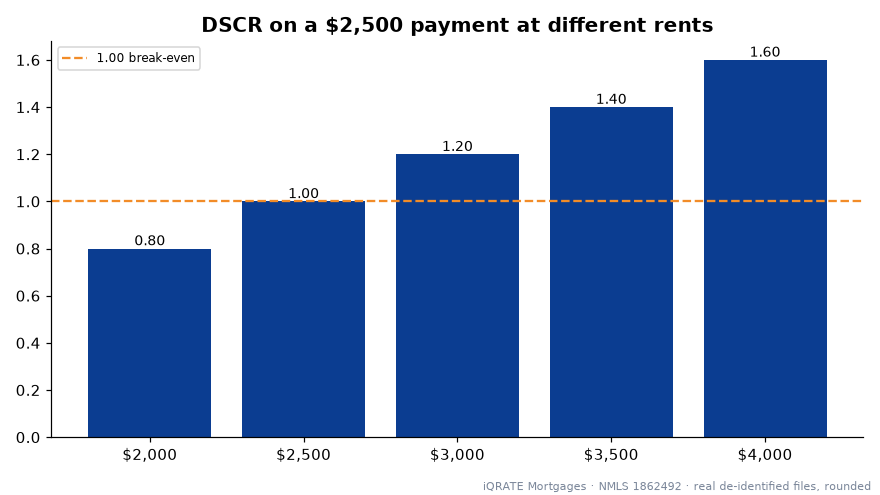
Simple ratio arithmetic, not a quote. 1.00 means the rent equals the full payment.
What makes McKinney's DSCR math specific?
McKinney keeps growing north and west along US-75 and the Sam Rayburn Tollway. Newer communities like Trinity Falls and Painted Tree sit beside older neighborhoods around the historic downtown square. Many buyers are relocating to North Texas for corporate jobs in Plano, Frisco and Allen. Strong school districts keep single-family rental demand high.
For a DSCR borrower, the city's big variable sits on the payment side of the ratio. Two homes at the same price can carry different tax bills, depending on the school district. Newer communities may also add a PID or MUD.
What are the McKinney figures that go into PITIA?
| Measure | Figure | What it means for the ratio |
|---|---|---|
| City of McKinney, 2025 | $0.415513 per $100 | Part of the tax line in PITIA |
| McKinney ISD, 2025 | $1.1043 per $100 | Other ISDs serve parts of the city at their own rates |
| Collin County, 2025 | $0.149343 per $100 | Collin College is added on top |
| City + McKinney ISD + county | About $1.67 per $100 | Before exemptions, Collin College and any PID or MUD |
| School-district homestead exemption, 2025 | $140,000 of value | Owner-occupants only; a rental pays without it |
| Collin County 2026 conforming limit, one unit | $832,750 | Matters if you compare a conventional investment loan; DSCR loan sizes are set by each lender |
| Transfer tax | None in Texas | No transfer-tax line in cash to close |
| State income tax | None in Texas | No state personal income tax |
Sources: City, ISD and county rates come from iQRATE's McKinney mortgage broker page. The conforming limit comes from FHFA conforming loan limits and the FHFA 2026 limit announcement. See also the Texas Comptroller property tax overview.
Which school districts serve McKinney addresses?
A McKinney home can be zoned to McKinney, Frisco, Prosper, Allen, Melissa or Lovejoy ISD, depending on the address. Each district has its own tax rate. Confirm the district for the exact parcel. Then build the ratio on that district's rate.
Do Texas homestead rules change a rental's tax bill?
Yes. Owner-occupants get the homestead exemption. After the first year, they also get a 10% cap on yearly appraisal increases. Those benefits apply only to a homestead. A DSCR loan is on a non-owner-occupied investment property, so don't claim a homestead exemption on the property you're financing as an investment.
This matters most when you buy from an owner-occupant. The seller's bill may reflect the homestead exemption and the 10% appraisal cap. Those are for owner-occupants, so budget the rental's tax on its own value, without the exemption or the cap.
Areas and ZIPs we lend in
These are the McKinney areas and ZIP codes iQRATE lends in. The notes describe each area and the checks that affect a DSCR ratio there. They don't describe any closed iQRATE loans.
| Area | ZIP | About the area | Check for the ratio |
|---|---|---|---|
| Historic Downtown McKinney | 75069 | Older homes around the square, with historic overlay rules for exterior changes | Roof age and insurance quote; overlay rules on exterior work |
| Stonebridge Ranch | 75070, 75071 | Master-planned community with an HOA and mature amenities | HOA dues go into PITIA; check leasing rules |
| Craig Ranch | 75070 | Master-planned community with an HOA; in some cases special district assessments | Dues plus any assessment |
| Eldorado | 75070 | Established area with mature amenities and HOA-run communities | HOA dues go into PITIA; check leasing rules |
| Tucker Hill | 75071 | Master-planned community with an HOA; in some cases special district assessments | Dues plus any assessment |
| Trinity Falls | 75071 | Newer community in north and west McKinney | Ask about PID or MUD; confirm the ISD |
| Painted Tree | 75071 | Newer community in north and west McKinney | Ask about PID or MUD; confirm the ISD |
| Erwin Farms | 75071 | McKinney neighborhood in ZIP 75071 | Confirm the ISD and any HOA dues |
North and east McKinney add newer construction and builder incentives. Some of those areas are zoned to Prosper, Frisco or Melissa ISD rather than McKinney ISD, and that changes the tax rate.
Which McKinney costs move the payment side of the ratio?
Property tax
Texas property taxes are high. They're billed each October and paid in arrears. At closing, lenders usually collect about 2–6 months of taxes into escrow, depending on the closing month. The seller's prorated tax credit for the months they owned the home offsets part of that. The Texas Comptroller explains how the property tax system works.
PID and MUD assessments
A public improvement district (PID) assessment pays for infrastructure in some newer communities. It's billed on top of property taxes. A MUD tax affects the ratio the same way. Every dollar of assessment goes into PITIA and lowers the ratio. Pull the exact bill before you offer.
Insurance and hail
North Texas hail makes roof age and the insurance deductible important. Hail claims push premiums and deductibles up, especially on older roofs. Some policies carry a percentage wind and hail deductible. A DSCR lender wants a landlord policy, also called a dwelling fire policy. The premium goes straight into PITIA, so get a quote before you offer. In Texas, title insurance premiums are set by the Texas Department of Insurance.
HOA dues and rental rules
Master-planned communities like Stonebridge Ranch, Craig Ranch and Tucker Hill have HOAs, and their dues count in PITIA. HOA rules also decide what kind of rental you can run, which is the next question.
Can you use a DSCR loan for a short-term rental in McKinney?
Check McKinney's ordinances and your HOA first, because many McKinney HOAs ban rentals under 30 days. If the HOA bans short stays, nightly income can't qualify the loan.
If the use is allowed, lenders generally take one of three approaches:
- Actual history: 12 months or more of booking-platform statements or a property manager's records.
- A market projection: a short-term rental income report from a data provider such as AirDNA. Some lenders accept one, with heavy scrutiny.
- Long-term rent only: the appraiser's long-term market rent. Many lenders use only this.
If your HOA bans short stays, plan around the long-term rent number. You can still run the home as a short-term rental where it's legal, but the loan shouldn't depend on that income.
Five checks to run before you offer on a McKinney rental
- Confirm the jurisdiction. Find the ISD, and find out whether the parcel sits in a PID or MUD.
- Build the tax line without the homestead exemption. Use the rental's value and the right district rate.
- Get a landlord insurance quote. Ask about the roof's age and the wind and hail deductible.
- Test the rent before the appraiser does. Compare the seller's rent with recent nearby leases, and run the ratio at a lower rent too.
- Check the property type and the rental plan. Condos may need a project review. Short-term rental income needs HOA and city approval.
From David: "You can close a DSCR deal with just about any problem as long as you put a bit more down. That's why we always tell clients the rate and down payment are tentative until the appraiser's value and rent come in."
How do lenders decide what a McKinney rental rents for?
On a DSCR loan, the appraisal sets the two numbers that decide your loan: the value and the market rent. The rent opinion usually comes on Fannie Mae Form 1007, the Single-Family Comparable Rent Schedule. On that form, the appraiser compares your property with nearby rentals.
Under the redesigned agency appraisal report (UAD 3.6), market rent moves into the report itself instead of a separate 1007. UAD 3.6 is required for new agency appraisals submitted on or after November 2, 2026. DSCR lenders set their own requirements, so you may see either format.
Which rent does the lender use? Some lenders use the signed lease. Some use the appraiser's market rent. Some use the lower of the two. Ask which rule applies before you pay for the appraisal.
On a 2–4 unit property, the ratio uses the combined rent from all units against one PITIA. Provide every lease.
What should you do before you offer? Don't rely on the seller's rent number alone. Pull recent leases on similar nearby homes with the same bedroom count and condition. Send us realistic rent comps before you offer, and run the ratio at a lower rent as well.
How much can a low rent opinion move the ratio?
| Ratio you expected | Rent comes in one-twentieth low | Rent comes in one-tenth low |
|---|---|---|
| 1.20 | 1.14 | 1.08 |
| 1.10 | 1.05 | 0.99 |
| 1.00 | 0.95 | 0.90 |
This is arithmetic, not a forecast. A deal that barely clears 1.00 on the seller's rent can fall short once the appraiser's rent comes back.
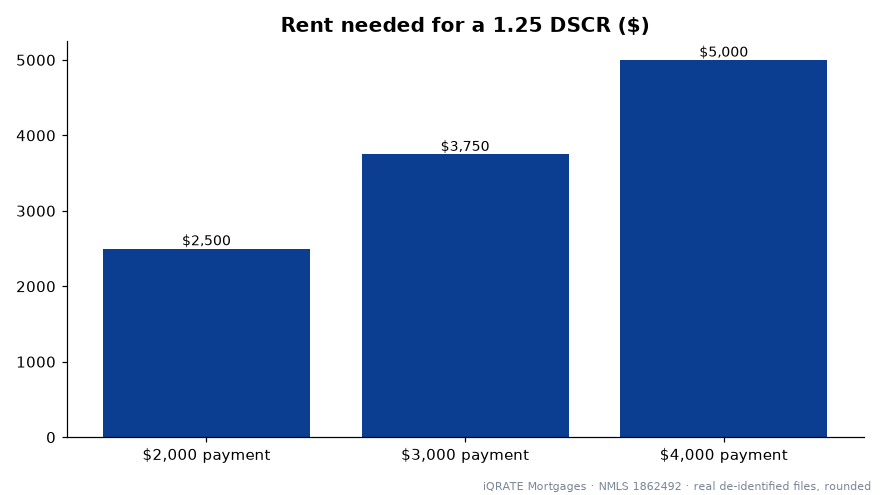
Simple math: multiply the payment by the target ratio to get the rent you need.
A full DSCR walkthrough for a McKinney rental, in round units
This walkthrough shows the order of the test. It uses round units, not dollars, and it isn't a quote.
Step 1: Set the rent. Recent leases on similar nearby homes point to 100 units a month. The seller says 110. Use 100, because the appraiser will look at the same leases.
Step 2: Build the payment. Principal and interest are 60 units. Property tax is 12, built on the rental's value without a homestead exemption. The landlord insurance quote is 8. HOA dues are 5. The full payment is 85.
Step 3: Divide. 100 ÷ 85 is about 1.18.
Step 4: Stress the rent. If the appraiser's rent comes in at 92, the ratio is about 1.08.
Step 5: Stress the tax line. Suppose the home sits in a PID, or the tax line rises after reassessment. If tax rises from 12 to 14, the payment becomes 87. On 92 of rent, the ratio is about 1.06.
Step 6: Decide. The deal still clears 1.00 at the lower rent and the higher tax. If it didn't, your options would be more equity, a different program or a different property.
What is the highest payment a given rent supports?
Divide the rent by the ratio the program needs. The result is the most PITIA the rent can carry.
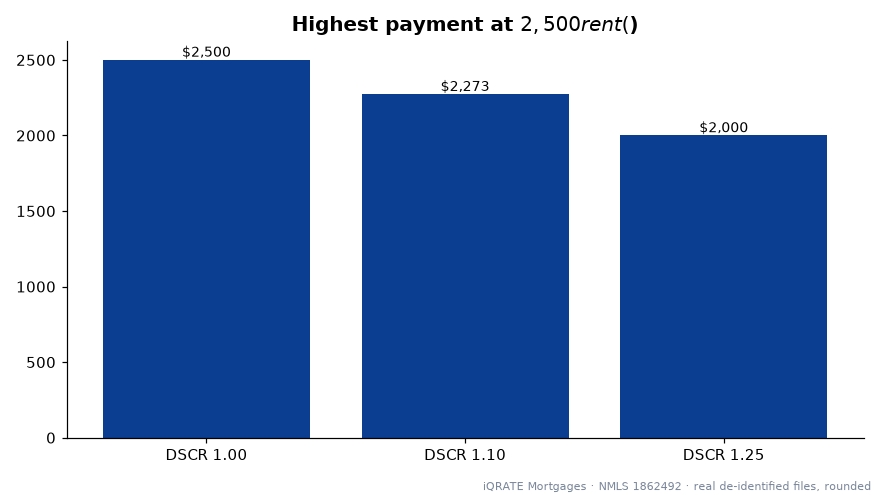
Simple math: rent divided by the target ratio. Not a quote or approval.
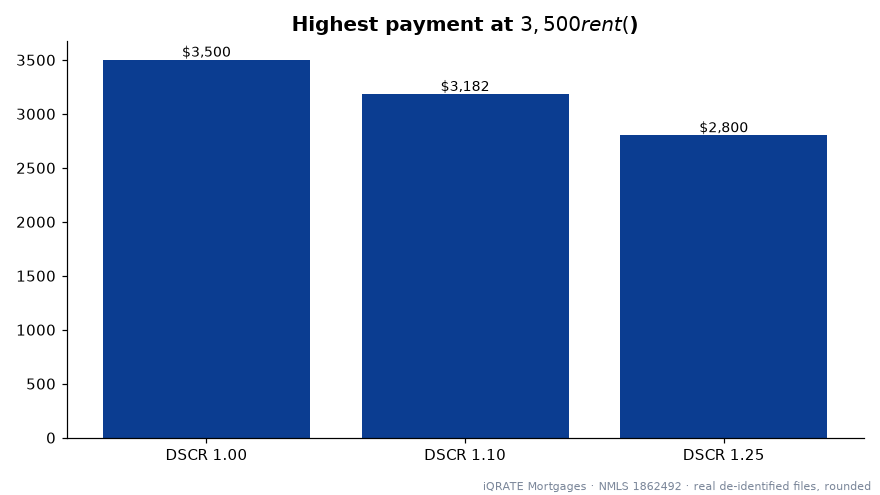
Simple math: rent divided by the target ratio. Not a quote or approval.
To run your own numbers, use iQRATE's mortgage calculators. Then send us the address, and we'll check the real tax bill and insurance quote.
What do the results mean?
| Ratio | What it usually means | What to do next |
|---|---|---|
| Above 1.20 | Rent covers the payment with room to spare | Confirm the rent and the tax bill, then compare terms |
| 1.00 to 1.20 | Rent covers the payment, but a small rent miss can matter | Run the lower-rent test before you offer |
| Below 1.00 | Rent doesn't cover the full payment | Look at more equity, a lower-ratio program or a different property |
What DSCR terms do lenders offer right now?
Every DSCR lender sets its own rules. The table below shows example terms from one lender iQRATE places loans with, as of October 2026:
| Term | Example from one lender | How lenders differ |
|---|---|---|
| Minimum DSCR | 0.75 | Some lenders stop at 1.00 |
| Ratio of 0.75 to 0.99 | A higher rate | The add-on differs by lender |
| No-ratio option | Available, at a higher rate | Not every lender offers one |
| Minimum credit score | 680 | Minimums differ by lender |
| Loan amounts | $75,000 to $5,000,000 | Very small and very large loans narrow the list |
| Reserves | 12 months of PITIA; on a cash-out refinance, the cash-out proceeds can count | Some lenders ask for less |
| Prepayment penalty | Periods from five years down to none | Each choice prices differently |
| Interest-only | Offered by some lenders | Not every lender offers it |
| LLC vesting | Allowed by some lenders; a personal guarantee is always required | Entity rules differ |
| First-time investors | Some lenders allow it, with extra occupancy review | Ask several lenders |
| Cash-out seasoning | At least 6 months on title, following Fannie Mae's rule | Some non-QM lenders allow cash-out right after an all-cash purchase |
These are one lender's example terms. Availability on Texas property is confirmed on your file. They are not a rate quote, a loan offer or a commitment to lend. Terms change often and depend on credit, property and lender approval. We don't publish rates because pricing moves daily.
What drives DSCR pricing?
- Credit score and equity. Higher scores and more equity usually price better.
- The ratio and the prepayment penalty. A ratio of 1.00 or higher prices best. A longer penalty usually lowers the rate.
- Loan size, property type and features. Very small or very large loans, condos, 2–4 units, short-term rentals, interest-only and cash-out can carry adjustments.
- Points. Paying points, or using seller or builder credits for a buydown, lowers the rate.
What if the McKinney ratio comes in below 1.00?
You have more options than walking away:
- Add equity. A smaller loan lowers the payment and raises the ratio.
- Use a program that accepts 0.75 to 0.99. At our example lender, that costs a higher rate.
- Use a no-ratio loan if nothing else works. The rate is higher still.
- Consider interest-only where offered. It raises the ratio, but you don't pay down principal during that period.
- Buy down the rate. It costs cash at closing. Seller or builder credits can sometimes pay for it.
- Pick a different property. Two homes at the same price can carry different ISD rates, PID bills and HOA dues.
- Walk away. If the deal only works on optimistic rent, we'll say so before your earnest money is at risk.
See no-ratio DSCR loans for programs with no minimum ratio.
How do DSCR prepayment penalties work?
A prepayment penalty is a charge for selling or refinancing within a set period. Penalty periods run from five years down to none, and each choice prices differently. A longer penalty generally buys a lower rate, and no penalty costs the most. iQRATE clients pick 2 years most often.
Lenders use several formulas. Some use a penalty that steps down each year. Some use a number of months of interest. Some use a fixed percentage for the whole term. Read the prepayment rider in your note before you sign.
Why can a DSCR loan carry a penalty at all? Regulation Z limits prepayment penalties on most consumer mortgages. Credit extended mainly for a business purpose, however, is exempt from Regulation Z (12 CFR 1026.3(a)). A loan on a non-owner-occupied rental held as an investment is that kind of credit. That's also why DSCR loans are only for investment property.
Which prepayment option fits your plan?
| Your plan | Option that often fits | Why |
|---|---|---|
| Buy and hold for many years | A longer penalty period | You're unlikely to pay it, and it usually buys a lower rate |
| Hold a few years, then sell or 1031 exchange | A shorter penalty period | Balances rate against the chance you sell early |
| Refinance again once the value rises | A short period or none | A refinance inside the period triggers the charge |
| Unsure | 2 years | The choice our clients make most often |
Ask these questions before you choose:
- Does the penalty apply to a sale as well as a refinance?
- Can you pay down part of the balance each year without a penalty?
- Is it a declining amount or months of interest?
- Does the rate you were quoted assume a particular penalty?
Get each answer in writing on the term sheet.
From David: "A loan that saves you money today can become expensive if you need to refinance or sell before a prepayment penalty expires."
How does a DSCR cash-out refinance work on a McKinney rental?
A DSCR cash-out refinance pulls equity out of a rental you own and qualifies on that rental's rent.
- Seasoning: at least 6 months on title, following Fannie Mae's rule. Some of our non-QM DSCR lenders offer cash-out with no seasoning after an all-cash purchase. You must document the funds you used to buy the property, and the lender may price the exception into the rate.
- Reserves: at one of our lenders, the cash-out proceeds can count toward reserves.
- Maximum loan-to-value: this varies by lender and credit score. We quote it on your actual file.
- The ratio still applies at the new, larger loan. More cash out means a bigger payment and a lower ratio.
- Check your current loan first. If your existing DSCR loan has a prepayment penalty, refinancing early may trigger it.
Do Texas homestead cash-out limits apply? Generally no. Texas Section 50(a)(6) limits cash-out loans on a homestead. A DSCR cash-out refinance is on a non-owner-occupied investment property, so those homestead rules don't apply to it.
Can you close a McKinney DSCR loan in an LLC?
Some DSCR lenders let you take title in an LLC, which is one reason investors choose DSCR over conventional financing. The lenders iQRATE uses for LLC closings always require a personal guarantee. Every member who guarantees the loan goes through credit and identity checks.
Expect to provide:
- Articles of organization
- The operating agreement
- The EIN letter (see the IRS EIN page)
- Proof the entity is in good standing
The Texas Secretary of State website is a starting point for Texas business-entity filings. If the LLC was formed in another state, ask your attorney whether it also needs to register in Texas. Set up the LLC before closing, not during underwriting. Late entity changes are a common cause of delays. Talk with your attorney and CPA about whether an LLC makes sense for you.
Can you use a DSCR loan in a 1031 exchange?
Yes. A DSCR loan can finance the replacement property. A 1031 exchange lets you defer capital gains tax when you sell one investment property and buy another. You generally have 45 days to identify the replacement and 180 days to close. The IRS summarizes the rules in its like-kind exchange tips.
DSCR loans fit the timeline because they don't re-document your personal income. Give us your sale date and both deadlines on day one. Get approved on the ratio before you identify properties. Coordinate with your qualified intermediary and tax adviser. This is general information, not tax advice.
Why do investors with strong income still choose DSCR?
Rental income and expenses are reported on Schedule E. The IRS covers residential rental property in Publication 527, Topic 414 and Topic 415. Write-offs can shrink taxable income, so a full-documentation loan may see less income than the investor actually has.
A DSCR loan usually fits:
- Self-employed investors whose write-offs shrink taxable income
- Growing portfolios, where each conventional loan adds to your debt-to-income ratio
- Investors who want to hold title in an LLC
- Out-of-state investors buying in McKinney
- Refinances of existing rentals
It's usually not the right loan if:
- You plan to live in the home, even part-time or in one unit of a duplex
- You're a W-2 earner with room in your debt-to-income ratio. A conventional investment loan often costs less.
- You'll sell or refinance within a year or two and the prepayment penalty would eat the gain
David is a real estate investor himself and has prepared more than 6,000 tax returns. That's why investor files get read the way an owner reads them: rent, taxes, insurance and HOA dues first, then the loan.
From David: "One thing being a real estate investor has taught me is that getting a loan approved and making a good investment are two different things. I've seen investors spend weeks negotiating a purchase price and then barely examine the financing terms. They focus on the interest rate. I look at the entire transaction: cash invested, monthly carrying costs, reserves, prepayment penalties, and the exit strategy."
Is a DSCR loan or a conventional loan better for a McKinney rental?
| Question | DSCR loan | Conventional investment loan |
|---|---|---|
| How you qualify | The property's rent compared with PITIA | Your personal income and debt-to-income ratio |
| Tax returns and W-2s | Generally not required | Required |
| Rent counted | The rent against the full payment | Subject-property rent typically counted at 75% of gross rent |
| Financed-property limit | Set by each lender | Up to 10 financed properties |
| Title in an LLC | Allowed by some lenders, with a personal guarantee | Generally not; title in your personal name |
| Prepayment penalty | Common, with options down to none | None |
| Reserves | 12 months at one of our lenders | Generally 6 months for the investment property, plus more for other financed properties |
| Typical pricing | Usually higher | Usually lower |
Choose conventional if your documented income carries the payment, you're under the property limit and you don't need an LLC. It's usually cheaper. Choose DSCR if your returns understate your income, your debt-to-income ratio is maxed out, you're past the limit or you want an entity. We can price both side by side. For agency reserve rules, see Fannie Mae's minimum reserve requirements.
How does DSCR compare with other investor loans?
| Option | How you qualify | Typical use | Main trade-off |
|---|---|---|---|
| DSCR loan | Property rent vs. full payment | Long-term rentals, LLC buyers, self-employed and full-time investors | More equity and a prepayment penalty in exchange for no income documents |
| No-ratio DSCR loan | Credit, down payment and reserves; no ratio test | Homes whose rent doesn't cover the payment | A higher rate |
| Conventional investment loan | Personal income, tax returns and DTI | Your first few rentals when your returns show strong income | No more than 10 financed properties |
| Bank statement loan | Deposits on 12 or 24 months of bank statements | Self-employed buyers, including some investment purchases | Income review still applies |
| Bridge or fix-and-flip loan | The property and your plan; short term | Buying a home that needs work before it can rent | Short term, usually interest-only, then refinance or sell |
| Blanket loan | Several properties under one loan | Investors consolidating a portfolio | Releasing one property usually requires a paydown |
See blanket loans, portfolio loans and bank statement loans for more on each.
Which property types qualify for a McKinney DSCR loan?
| Property type | Lender acceptance | What to watch |
|---|---|---|
| Single-family home | The most widely accepted | Tax district, HOA dues, roof and insurance |
| Townhome | Widely accepted | HOA dues count in PITIA |
| Warrantable condo | Widely accepted | Project review and HOA dues |
| Non-warrantable condo | Fewer lenders | Usually needs more equity |
| 2–4 units | Accepted | Combined rent from all units against one PITIA; provide every lease |
| 5–8 units and mixed-use | Some lenders offer residential-style programs | Larger properties move into commercial lending |
| Short-term rental | Some lenders | HOA and city approval; many McKinney HOAs ban rentals under 30 days |
For buildings with five to eight units, see DSCR loans for 5-8 unit small multifamily. If you're not a U.S. citizen or resident, see foreign national DSCR loans.
What real iQRATE DSCR files show
These are real files from David's desk. They're Las Vegas and out-of-state files, not McKinney closings. Names and details are removed, and figures are rounded. Each one shows a DSCR rule at work.
From David: "I have been a mortgage broker for more than 15 years. Every file has a moment where it could go either way."
Las Vegas new construction: the builder's lender said no
A client came to us after the financing on her brand-new Las Vegas investment property fell apart. To get the builder's incentives, she had to apply through the builder's preferred lender. She did exactly what the builder asked, and then the builder's lender denied her loan.
Because she had satisfied the builder's requirement to apply through its lending channel, the builder ultimately agreed to honor the incentives if she obtained outside financing. We arranged a DSCR mortgage using the property's rental income, and we applied the builder incentives toward a rate buydown. The resulting mortgage had a debt-service coverage ratio of approximately 1.00. We closed in less than three weeks.
"The lesson I took from that transaction is that a lender's denial doesn't necessarily mean a good investment opportunity is dead. Sometimes the solution is understanding the purchase contract, preserving the buyer's negotiating position, and choosing a financing program that fits the actual investment."
— David Ghazaryan
Las Vegas condo cash-out: rent that covered only 83% of the payment
In fall 2023, an investor wanted to pull cash out of a Las Vegas condo rental appraised at $280,000. The rent covered only about 83% of the new payment, a DSCR of 0.83. Low leverage did the heavy lifting, and the cash-out refinance funded in fall 2023.
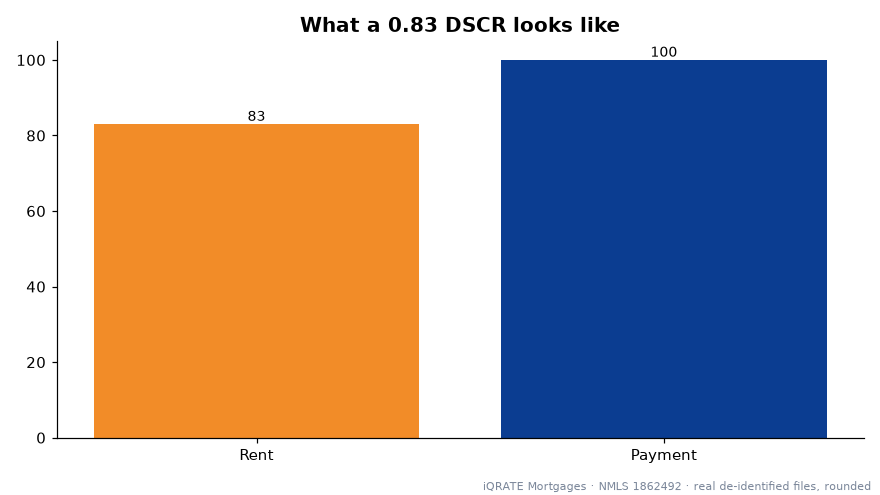
Las Vegas file. The rent paid 83 cents of every payment dollar, and the loan still closed.
Two Las Vegas condos: a 0.82 ratio, closed the same day
In fall 2024, a Las Vegas investor with five or more rentals bought two condos in the same southwest Las Vegas complex and closed both on the same day. The appraiser's rent pushed the ratio down to 0.82, below 1.0. The loan stayed approved because the down payment and reserves carried it.
Las Vegas purchase: a 200% debt ratio that didn't matter
In fall 2023, a buyer with strong credit wanted a Las Vegas rental home near $420,000. Her income came mostly from capital gains and dividends. Run through a full-doc loan, her debt ratio came out above 200%. We stopped looking at her income and looked at the house instead. The rent produced a DSCR of 1.18, and she closed in fall 2023.
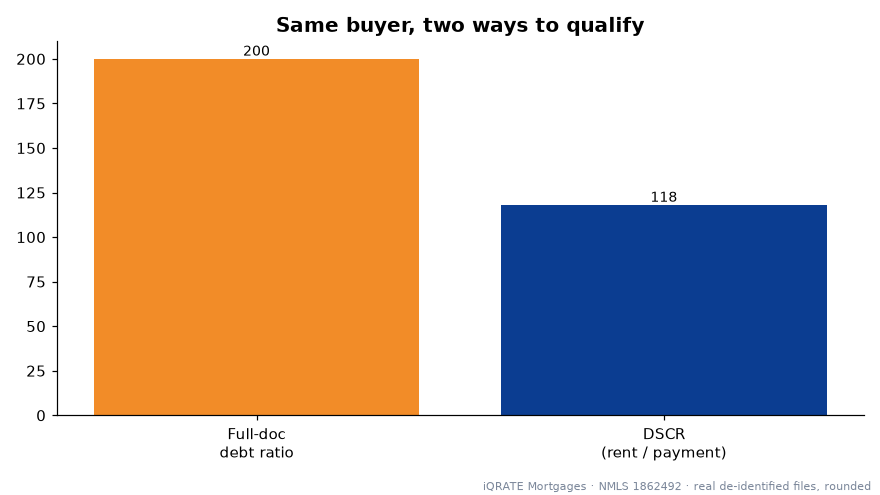
Las Vegas file. On rent, the property covered itself.
LLC refinance: $130,000 low, and the loan still went up
In 2024, an investor was refinancing a rental owned in an LLC with a DSCR loan. We expected a $1 million value, but the appraisal said $870,000. The loan started well below the value, so there was room to spare. We raised it from $400,000 to $435,000, and final pricing improved.
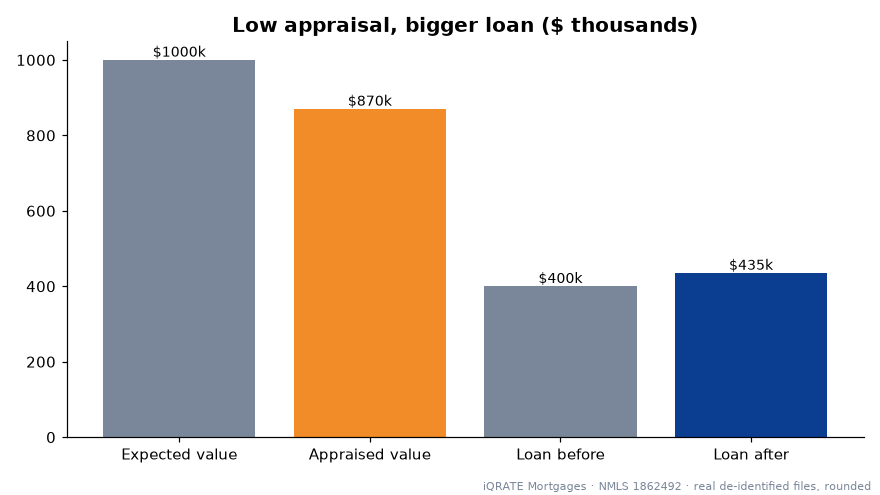
The value came in $130,000 low. The loan still went up.
Midwest small-balance rental: closed in 13 days
A Nevada investor's LLC owned a $160,000 single-family rental in the Midwest. Many lenders won't touch a balance that small, so we placed it with a small-balance DSCR program. The appraisal came in $50,000 high, and the DSCR was 1.45. Submission to clear to close took 13 days.
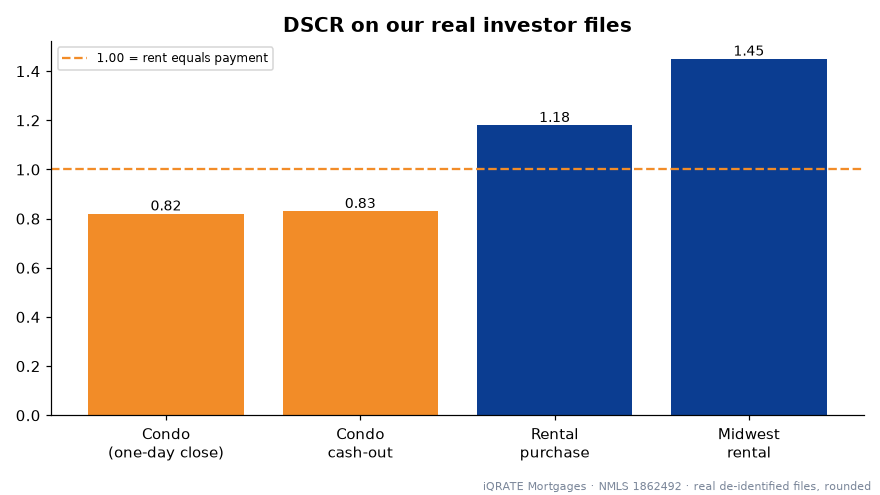
Ratios from the files above. Two closed with rent below the payment.
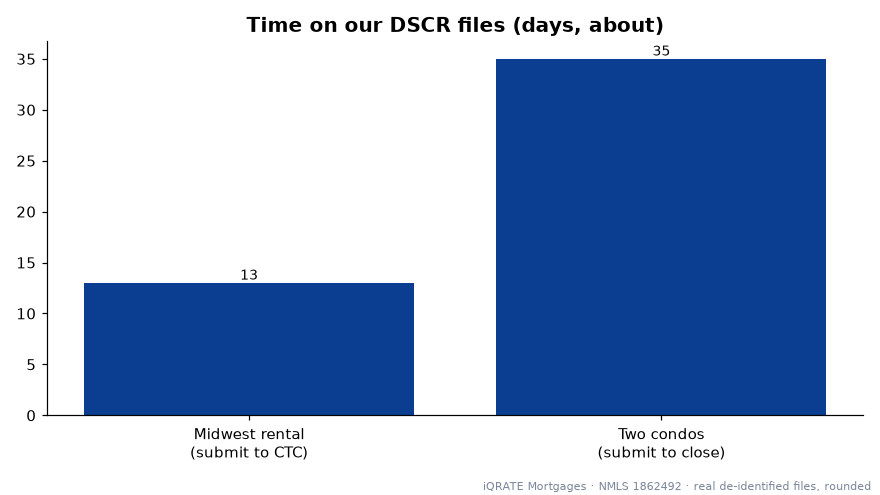
A clean small-balance file moved in 13 days. A two-condo project review took about five weeks.
Las Vegas foreign-national purchase
In spring 2023, a past client referred a foreign-national investor who wanted a Las Vegas rental home near $435,000. The buyer's funds sat in overseas bank accounts. We used a DSCR loan that qualifies on the home's rent, and we documented the funds with overseas bank statements. The purchase closed in spring 2023, and pricing improved between the first and the final approval.
What can a McKinney investor take from these files?
| File | What nearly stopped it | What decided it | What to apply in McKinney |
|---|---|---|---|
| Las Vegas new construction | The builder's lender denied the loan | The client had met the builder's requirement | Keep a written record of every builder step in north and west McKinney new construction |
| Las Vegas condo cash-out | Ratio of 0.83 | Low leverage | Know how much loan the rent can carry before you set a cash-out amount |
| Two Las Vegas condos | Appraiser's rent pushed the ratio to 0.82 | Down payment and reserves | Run the ratio at the appraiser's likely rent, not the seller's |
| Las Vegas purchase | Full-doc debt ratio above 200% | Qualifying on rent at 1.18 | Don't force a full-doc loan when the house qualifies on its own |
| LLC refinance | Appraisal $130,000 below expectation | Room between the loan and the value | Leave room for a value surprise |
| Foreign-national purchase | Funds in overseas accounts | Documented statements | Start the funds paper trail early |
Real iQRATE files from Las Vegas and out of state, not McKinney closings. Names and details are removed, and figures are rounded. Past results don't guarantee future outcomes. All loans are subject to credit approval.
What mistakes sink DSCR deals in McKinney?
- Using the seller's rent. The appraiser's number decides the ratio.
- Using the seller's homestead tax bill. A rental pays tax without the homestead exemption.
- Missing a PID or MUD. Either one adds to PITIA.
- Assuming the ISD. Confirm the district for the exact parcel; it sets the rate.
- Getting the insurance quote late. Hail-driven premiums can push the ratio under 1.00.
- Planning a short-term rental the HOA bans. Many McKinney HOAs ban rentals under 30 days.
- Forming the LLC during underwriting. Late entity changes cause delays.
- Picking the wrong prepayment penalty. A long penalty can be expensive if your plan changes.
The most common delays are a low appraised rent, a late insurance quote and LLC paperwork that isn't ready.
How do you choose a DSCR lender or broker for a McKinney rental?
There's no official ranking of DSCR lenders. The best one is the one whose guidelines fit your deal. Compare the minimum ratio, short-term rental rules, condo acceptance, LLC vesting, prepayment options, reserves and closing speed.
Broker vs. going direct to one DSCR lender
| What you're comparing | Direct DSCR lender | DSCR mortgage broker (iQRATE) |
|---|---|---|
| Loan programs | One lender's guidelines | Many wholesale lenders' guidelines, more than 100 on complex deals |
| If your ratio is under 1.00 | Approved or declined on that lender's floor | Matched to lenders that accept lower ratios, or the deal is restructured |
| Short-term rental income | Accepted or not, by that lender's rules | Matched to lenders that accept it, when the property qualifies |
| Condos | Often limited | Matched to lenders that take the project |
| Prepayment choices | That lender's menu | Compared across lenders |
Comparison is general. Each lender sets its own guidelines. Not a commitment to lend.
DSCR loans aren't standardized like Fannie Mae or FHA loans. Each lender uses its own risk underwriting, so the same property can get a "no" from one lender and a good offer from another.
From David: "On a complicated deal, I'll personally email more than 100 lenders and sift through what comes back. It's a lot of work, so I do it once the client is committed, with a full application and documents in hand."
Questions to ask any McKinney DSCR lender
- What is your minimum DSCR, and which rent do you use: the lease, the appraiser's market rent or the lower of the two?
- Will you count short-term rental income, and what proof do you need?
- Will you lend on this condo project, and does it need a project review?
- Can I close in an LLC, and what personal guarantee do you require?
- Which prepayment options do you offer, and does each one apply to a sale as well as a refinance?
- How many months of reserves do I need, and can cash-out proceeds count?
- Is there a seasoning period before a cash-out refinance?
- What is your NMLS number, and are you licensed in Texas?
If a lender can't answer these in writing, keep shopping.
How does a McKinney DSCR file move through iQRATE?
- Send us the scenario: the address, price, expected rent, last tax bill, an insurance quote, HOA dues and how you'll hold title.
- We confirm the ISD and any PID or MUD, then run the ratio conservatively with the full payment and a realistic rent.
- We shop DSCR lenders once your application and documents are in, and we get the key terms before you commit.
- Application and credit. No tax-return package is needed.
- Appraisal with rent analysis. We order it right away. Your rate and down payment are tentative until it comes back.
- Underwriting: assets, reserves, insurance, entity documents and the final ratio.
- Clear to close and funding, with local escrow and title.
iQRATE Mortgages is based in Las Vegas and licensed in Texas, Nevada, California and Florida.
What documents do you need?
| Item | Purchase | Rate-and-term refinance | Cash-out refinance | In an LLC |
|---|---|---|---|---|
| Photo ID and credit authorization | Yes | Yes | Yes | Yes, for each guarantor |
| Purchase contract | Yes | No | No | In the LLC's name, or an assignment the lender accepts |
| Lease or rent evidence | Lease if tenant-occupied; otherwise the appraiser's rent schedule | Current lease and proof of rent received | Current lease and proof of rent received | Same as the transaction type |
| Bank or brokerage statements | Funds to close and reserves | Reserves | Reserves (cash-out may count at some lenders) | LLC or personal accounts |
| Mortgage statements | Other financed properties | This property and others | This property and others | Same |
| Insurance | Landlord (dwelling fire) policy quote | Current policy | Current policy | Policy naming the LLC as insured |
| HOA information | Contact and dues; condo questionnaire for condos | Current dues | Current dues | Same |
| Entity documents | Not needed if buying in your name | Only if vested in an entity | Only if vested in an entity | Articles, operating agreement, EIN letter, proof of good standing |
Tax returns, W-2s and pay stubs are generally not required. Lenders may ask for more.
What clients say about iQRATE Mortgages
These are real reviews, quoted word for word. They describe working with David Ghazaryan and the iQRATE team overall. They aren't presented as McKinney loans, and none is a promise about your loan.
"Andrei and David were so great! They're helpful and communicated everything with me through the whole process. I am so pleased and look forward to using iqrate for my future investment properties. 10/10 Will be reccomending to friends."
— Kassandra Arthur, review on Google
"David and Andrei and team were very knowledgeable and really helped in the whole process. Even though the economy is going through a rough time they were able to explain every detail and really looked out for our best interest! I would highly recommend their team as they will find a way to get it done!"
— Lydia Z. (Menifee, CA), 5-star review on Yelp
Read more of David's reviews on Experience.com or on our reviews page. You can also watch iQRATE's mortgage videos.
McKinney DSCR loan FAQs
Are DSCR loans available for rentals in McKinney, TX?
Yes. iQRATE Mortgages (NMLS 1862492) is licensed in Texas and arranges DSCR loans on non-owner-occupied rentals in McKinney. The loan qualifies on the rent compared with the full payment, not on your tax returns.
How does the McKinney tax rate affect my DSCR?
Property tax is part of PITIA, so a higher tax line lowers the ratio. For 2025, the city, McKinney ISD and Collin County rates total about $1.67 per $100. That total is before exemptions, Collin College and any PID or MUD. A rental pays without the homestead exemption.
Does a PID or MUD lower my ratio?
Yes. Both are billed on top of property taxes, and lenders count them in the payment. Pull the parcel's exact bill before you offer.
Does the school district change my DSCR?
It can. A McKinney address may be zoned to McKinney, Frisco, Prosper, Allen, Melissa or Lovejoy ISD, and each one has its own rate. Confirm the district for the exact parcel, then build the ratio on that district's rate.
Can I count Airbnb income on a McKinney DSCR loan?
Only if the use is allowed. Many McKinney HOAs ban rentals under 30 days, so check the HOA and city rules first. Some lenders accept an AirDNA report with heavy scrutiny, and many use long-term rent only.
What rent will the lender use?
It depends on the lender. Some use the signed lease, some use the appraiser's market rent, and some use the lower of the two. Ask before you pay for the appraisal.
Do I need tax returns for a DSCR loan?
Generally no. Tax returns, W-2s and pay stubs are usually not required. You still need a credit check, asset statements, an appraisal with a rent analysis and proof of insurance.
Can a DSCR loan close with a ratio below 1.00?
Sometimes. One of our lenders accepts ratios as low as 0.75, at a higher rate. Others stop at 1.00. More equity or a different property is often the better route.
Can a first-time investor get a DSCR loan?
Some lenders allow it, with extra occupancy review. The lender must be satisfied that you won't move into the property. If one lender says no, we ask others.
Can I close in an LLC?
Yes, with some lenders. The lenders we use for LLC closings always require a personal guarantee. Have the articles, operating agreement, EIN letter and proof of good standing ready before closing.
Do Texas homestead cash-out limits apply to my rental?
Generally no. Section 50(a)(6) limits cash-out on a homestead, and a DSCR cash-out refinance is on a non-owner-occupied investment property.
How long must I own a rental before a DSCR cash-out?
Usually at least 6 months on title, following Fannie Mae's rule. Some non-QM lenders allow cash-out right after an all-cash purchase, as long as the purchase funds are documented.
How does North Texas hail affect a DSCR loan?
Hail claims push premiums and deductibles up, especially on older roofs. The landlord policy premium goes straight into PITIA, so a high quote lowers the ratio.
Is there a transfer tax on a McKinney rental purchase?
No. Texas has no real estate transfer tax.
Can I live in a home I buy with a DSCR loan?
No. DSCR loans are for non-owner-occupied investment property only. If you plan to live there, see our McKinney mortgage broker page for owner-occupied options.
Can I use a DSCR loan in a 1031 exchange?
Yes. A DSCR loan can finance the replacement property. You generally have 45 days to identify a replacement and 180 days to close, so start the loan on day one.
How fast can a McKinney DSCR loan close?
It depends on the appraisal, the insurance quote and the entity documents. The appraisal is usually the longest step, so we order it right away.
Why doesn't this page list DSCR rates?
Pricing changes daily. It moves with credit, equity, the ratio, the prepayment option, loan size and property type. Terms are confirmed on your actual file, in writing on the term sheet.
Get started
Tell us about the McKinney property. We'll confirm the ISD and any PID or MUD, run the ratio and shop DSCR lenders. Then we'll tell you plainly whether the deal works.
Schedule a free consultation · Call or text (702) 766-3744 · Apply now
More on DSCR:DSCR loan program overview · Texas DSCR loans · Dallas DSCR loans · McKinney mortgage broker · Real estate investor loans · Calculators
Related iQRATE pages
- Houston DSCR loans
- DSCR loans in San Antonio and Austin
- Texas mortgage broker
- Serial investor loans
- Non-QM loans
- P&L statement loans
- Self employed
- Refinance
- Closing costs by state
- Guarantees
- About
- FAQ
- Jumbo
- FHA loans
- VA loans
- First time home buyer
- Blog
Other Texas cities iQRATE lends in
- Amarillo
- Arlington
- Austin
- Corpus Christi
- Dallas
- El Paso
- Fort Worth
- Frisco
- Houston
- Katy
- Killeen
- Laredo
- Lubbock
- New Braunfels
- Plano
- San Antonio
- The Woodlands
- Tyler
- Waco
Talk with iQRATE about this loan
Apply now or contact us to get a quote on the property you have in mind. You can also schedule a call or book a call with David at (702) 766-3744. This is not a commitment to lend.
Sources
- iQRATE Mortgages, McKinney mortgage broker page: 2025 City of McKinney, McKinney ISD and Collin County rates; homestead exemption; ISDs; PID, MUD, hail and HOA notes; areas and ZIPs.
- iQRATE Mortgages, DSCR loans page: example lender terms (October 2026), rent-schedule and UAD 3.6 notes, prepayment options, Regulation Z business-purpose exemption (12 CFR 1026.3(a)) and case files.
- FHFA, conforming loan limits and FHFA 2026 conforming loan limit announcement.
- Texas Comptroller, property tax.
- Texas Department of Insurance.
- Texas Secretary of State.
- Fannie Mae Selling Guide B3-4.1-01, minimum reserve requirements.
- IRS, like-kind exchanges.
- IRS, get an employer identification number.
- IRS, Schedule E; IRS Publication 527; IRS Topic 414; IRS Topic 415.
- Experience.com reviews of David Ghazaryan.
Local figures come from iQRATE's McKinney mortgage broker page, last updated October 13, 2026.
Licensing and disclosures
iQRATE Mortgages LLC · 6360 S Rainbow Blvd Ste 101, Las Vegas, NV 89118 · Licensed in NV, CA, TX and FL · Company NMLS 1862492 · David Ghazaryan, Mortgage Broker, NMLS 1486726 · (702) 766-3744.
DSCR loans are business-purpose loans for non-owner-occupied investment property, not for a home you or your family will live in. Investor loans are for business purposes only. Not all borrowers qualify. Terms subject to underwriting and change. Lender terms on this page are examples from specific lenders as of October 2026, and the ratio examples are arithmetic only. Nothing on this page is a rate quote or loan offer, and it is not a commitment to lend. Programs are subject to credit, property and lender approval, and terms can change without notice. Client files are de-identified Las Vegas and out-of-state files, not McKinney closings, and past results don't guarantee future outcomes. All loans are subject to credit approval. Nothing on this page is tax or legal advice. Equal Housing Opportunity. iQRATE Mortgages LLC NMLS 1862492. David Ghazaryan NMLS 1486726.