Which Miami home loan fits me?
I am David Ghazaryan, a mortgage broker licensed in Florida. I help Miami buyers and investors pick the right loan for the home they want. Miami is not an easy place to borrow. Condo buildings get checked as closely as you do. Insurance can cost almost as much as the loan. Taxes change the day you buy. And the same buyer can be approved at one lender and turned down at the next. This guide walks through each loan type. It shows who each one fits and what it costs. It also covers the Florida rules that decide most Miami files. Each example is just math, not a quote. Each number links to the agency or official source that put it out.
Start with two questions. Will you live in the home? And how will you prove your income? Those two answers rule out most loan types before we even look at price. The table below is the short version. The rest of this guide explains each row.
| If this sounds like you | Look first at | Why it fits | Watch out for |
|---|---|---|---|
| You will live in the home and have steady W-2 or tax-return income | Conventional loan | Low down payment choices on a main home, and mortgage insurance that can come off | The condo building must meet Fannie Mae or Freddie Mac rules |
| You will live in the home and have a small down payment or credit you are rebuilding | FHA loan | 3.5% down with a credit score of 580 or higher | Very few Miami condo buildings are FHA approved |
| You are a veteran or service member buying a main home | VA loan | No down payment with full entitlement and no VA loan limit | The condo project must be VA approved |
| Your loan will be above $832,750 | Jumbo loan | Covers Coral Gables, Pinecrest, Key Biscayne and Miami Beach prices | Each lender sets its own down payment, reserve and condo rules |
| You own a business and your tax returns show less than you really earn | Bank statement loan | Qualifies on deposits, not tax returns | Costs more than a conventional loan and needs more down |
| You are buying a rental and want the rent to qualify the loan | DSCR loan | No personal income test, and it can close in an LLC | Insurance, taxes and condo dues can sink the ratio |
| You live outside the U.S. and have no U.S. credit | Foreign national loan | Uses passports, foreign credit letters and checked assets | A larger down payment, and funds must be moved early |
| The condo building fails agency rules | Non-warrantable condo loan | Some lenders fund buildings Fannie Mae will not | Most often more down and higher pricing |
Most of my Miami clients fit more than one row. Take a self-employed buyer of a Brickell condo. She might qualify for a conventional loan, a bank statement loan or a jumbo loan. It depends on the building and the price. I price each path that fits. Then we pick the one with the lowest total cost over the time you plan to keep the loan.
Why does it matter if I will live in the home?
A loan for a home you live in is a consumer loan. A loan for a rental you will not live in is seen as business credit. The CFPB's official interpretation of Regulation Z, comment 3(a)-4, spells this out. Credit to buy or fix up a rental that the owner does not live in is business credit. That is true no matter how many units it has. If you plan to stay in the home more than 14 days in the coming year, it is not seen as a rental the owner does not live in. That is why investor lenders ask you to sign a business-purpose and occupancy statement. Never sign one if you plan to live there. Occupancy fraud is a serious crime. It is never worth it.
The answer also changes your down payment. You can buy a main home with as little as 0% to 3.5% down. It depends on the loan type. A second home or a rental needs more. And only rentals can use a DSCR loan, which skips the personal income test.
How will I prove my income?
- Full documentation: W-2s, pay stubs and tax returns. This opens conventional, FHA, VA and most jumbo loans.
- Bank statements: 12 or 24 months of deposits for business owners. This opens bank statement loans. These are non-QM loans.
- The property's rent: for rentals only. This opens DSCR loans.
- Assets: some lenders qualify you on large cash assets in place of income.
- Foreign income or no U.S. history: this opens foreign national and ITIN loans.
How do Miami buyers actually finance their homes?
Each mortgage lender reports loan data under the Home Mortgage Disclosure Act. I pulled the 2025 file for Miami-Dade County from the FFIEC HMDA Data Browser. I counted first-lien loans that closed and were used to buy a home. I left out home equity lines of credit. That came to 17,259 loans from 444 lenders. It is the fullest public picture of how Miami buyers really pay for homes.
Conventional loans were 13,234 of them, or 76.7%. FHA loans were 3,646, or 21.1%. VA loans were 379, or 2.2%. Jumbo loans, the ones above the FHFA limit, were 2,068, or 12.0%. Loans on rentals were 3,540, or 20.5%. Second homes were 358, or 2.1%. Loans with an adjustable or intro rate were 1,573, or 9.1%. Interest-only loans were 866, or 5.0%. Two- to four-unit homes were 404, or 2.3%. Other counts that sort the data in a new way will show slightly different totals.
In plain English: one in five Miami-Dade loans to buy a home in 2025 paid for a rental. One in eight was a jumbo. One in eleven had an adjustable or intro rate. Miami buyers use less common loans far more than most places do. A lender that only offers plain 30-year conforming loans will miss a large share of real Miami files.
Down payments vary a lot too. Of the 16,526 loans that showed a combined loan-to-value, 9.6% borrowed 60% or less. So they put 40% or more down. Another 39.8% borrowed over 60% to 80%. Then 11.5% borrowed over 80% to 90%. And 14.2% borrowed over 90% to 95%. The last 25.0% borrowed more than 95%, mostly with FHA and VA loans. The median loan to buy a home was $485,000. The median value shown was $565,000. Some loans showed a debt-to-income ratio. Of those, 15.3% were at 50% or higher. High ratios are common here because Miami pay trails Miami prices. That is just where the choice of lender and the way we build the file matter most.
What is the Miami market doing right now?
Miami-Dade is really two markets. Houses are tight. Condos have more supply than buyers. In September 2026, the county's median single-family sale price was $692,000. That was up 4.06% from a year before. The median condo and townhouse price was $417,090, down 0.69%. Single-family homes had 5.1 months of supply. Condos had 12.3 months. And 49.4% of condo sales were paid in cash, against 26.2% of house sales (MIAMI REALTORS, September 2026 report). October looked much the same. The single-family median was $706,000 and the condo median was $397,500. Condos had 12.7 months of supply (MIAMI REALTORS, October 2026 report).
That split matters for your loan. Close to half of condo buyers pay cash. So a condo offer with a loan has to compete with cash. It needs a full approval from an underwriter before you write. You need the condo form ordered on day one and an insurance quote in hand. But a year of condo supply also gives a buyer with a loan room to ask the seller for help with closing costs, within the loan's limits. On a house, with about five months of supply, a strong and fast approval matters more than haggling.
How much can I borrow in Miami before I need a jumbo loan?
Each year the Federal Housing Finance Agency sets the largest loan Fannie Mae and Freddie Mac can buy. For 2026, the one-unit limit in Miami-Dade is $832,750. Two units is $1,066,250. Three units is $1,288,800. Four units is $1,601,750 (FHFA, 2026 conforming loan limits; FHFA county limit file). Broward and Palm Beach have the same limits. FHFA's high-cost ceiling of $1,249,125 does not apply in South Florida. Here, a one-unit loan above $832,750 is a jumbo loan.
At what price does my loan become a jumbo?
The limit applies to the loan, not the price. So your down payment decides where you cross the line. The math is simple. Divide the limit by the share you borrow. With 3% down, the top price that stays under the limit is about $858,505. With 5% down, it is about $876,579. With 10% down, it is about $925,278. With 15% down, it is about $979,706. With 20% down, it is about $1,040,938. With 25% down, it is about $1,110,333. With 30% down, it is about $1,189,643.
That is just math. The loan must still fit the credit, income and home rules of the loan type. Take a buyer at the September single-family median of $692,000. She stays under the limit even with 3% down. A buyer at $1,000,000 needs about 17% down to stay under the limit.
Worked example: three ways to finance a $1,000,000 home
Here is one $1,000,000 main-home purchase, set up three ways. These are ways to build the loan, not offers. Your Loan Estimate shows the real cost.
- Jumbo first mortgage: $1,000,000 − $100,000 down = a $900,000 jumbo loan. Fewer lenders allow 10% down on a jumbo. And they want more cash left over.
- Conforming loan at the limit: $1,000,000 − $832,750 = $167,250 down, about 16.7%. More cash goes in. But you get agency rules and pricing.
- Conforming first plus a second: an $800,000 first loan plus a $100,000 second loan = $900,000 borrowed with 10% down. Compare the blended cost of both loans. Then check the terms of the second.
None of these is always best. If you have the cash, the middle one often has the simplest review. If you want to keep cash in the bank, price the first and third side by side.
What does a jumbo lender look at?
Fannie Mae and Freddie Mac do not buy jumbo loans. Each lender writes its own rules. That means more choice. It also means the best jumbo for you may sit at a lender you have never heard of. Most jumbo lenders look at the same five things. First is the down payment. Each lender sets it by loan size, and larger loans tend to need more down. Second is credit. Jumbo lenders tend to want a higher credit band than conforming lenders. A score in the 700s opens more loans. Third is reserves. That means months of payments left in your accounts after closing. Larger loans tend to need more months. Fourth is debt-to-income. Insurance, taxes and condo dues all count here. Fifth is the building. Prime jumbo lenders often want a condo that meets agency rules. A non-warrantable tower goes to a non-QM or portfolio lender, and most often with more down. Read more on jumbo loans and on jumbo loans for non-warrantable Miami condos.
In 2025, Miami-Dade had 2,068 jumbo loans to buy homes. The median loan was $1,285,000 (FFIEC HMDA). Of them, 542 were under $1 million. Then 1,062 were $1 million to under $2 million. And 238 were $2 million to under $3 million. Then 140 were $3 million to under $5 million. The last 86 were $5 million and up. Most were for main homes: 1,511, against 148 second homes and 409 rentals. And 781 of them, or 37.8%, had an adjustable or intro rate. That is about four times the share in the market as a whole. Interest-only jumbos were 315, or 15.2%. Most jumbo buyers still put 20% or more down. Of the 1,901 jumbo loans that showed loan-to-value, just 337 were above 80%.
Where are jumbo loans the norm? The U.S. Census Bureau puts the median value of homes lived in by their owners at $1,575,300 in Key Biscayne. It is $1,406,400 in Pinecrest and $1,089,900 in Coral Gables. The county as a whole is $463,000 (Census QuickFacts, ACS 2020 to 2024). These are owner guesses spread over five years. So they run below today's sale prices. They still show where a jumbo loan is the rule, not the odd case.
Should my jumbo be fixed, adjustable or interest-only?
A fixed rate stays the same for the whole term. So your principal and interest payment never changes. An adjustable rate, or ARM, is fixed for a first stretch, often 5, 7 or 10 years. Then it can move up or down within caps. The CFPB explains that payments can rise after that first stretch. An interest-only loan lets you pay only interest for a set time. Then payments rise to pay back the principal. The CFPB's key mortgage terms explain how it works. You build no equity through your payments in the interest-only years.
An adjustable or interest-only jumbo can make sense in some cases. Maybe you expect a large bonus, a business sale or a move within the fixed stretch. It is a poor fit if your budget only works at the first payment. Do not count on selling or refinancing before it adjusts. See our Florida interest-only jumbo guide for more.
Is a conventional loan right for me in Miami?
A conventional loan follows Fannie Mae or Freddie Mac rules. It was 76.7% of Miami-Dade loans to buy homes in 2025. It fits buyers with income on paper, a solid credit history and a home that meets agency rules. On a condo, the building has to pass too. I cover that in the condo part below.
How much do I need down on a conventional loan?
It depends on how you will use the home. Fannie Mae's Eligibility Matrix sets the limits. A one-unit main home with a fixed rate can go up to 97% loan-to-value. That is 3% down. First-time buyer rules apply unless you use HomeReady. A two- to four-unit main home goes up to 95%, so 5% down. A one-unit second home goes up to 90%, so 10% down. A one-unit rental goes up to 85%, so 15% down. A two- to four-unit rental goes up to 75%, so 25% down. The occupancy types are defined in Selling Guide B2-1.1-01. Freddie Mac's limits are close to these. If you put less than 20% down, you pay private mortgage insurance. You pay it until you build enough equity to drop it.
Who should choose conventional over FHA?
Four groups tend to do better with conventional. The first is buyers with credit in the 700s. They often pay less on conventional, because FHA charges mortgage insurance for most of the loan's life. The second is condo buyers. They often have no choice. A conventional loan can fund a warrantable building that is not on FHA's short approved list. The third is second-home buyers. They need conventional or jumbo, because FHA is for main homes only. The fourth is investors with income on paper and only a few homes with loans. They can use conventional for rentals.
How many financed properties can I have?
Say you run a second home or a rental through Fannie Mae's automated system. The cap is 10 homes with loans, per Selling Guide B2-2-03. Past that, investors move to DSCR or portfolio loans.
Can I buy in Miami with a small down payment?
Yes, if you will live in the home. FHA, VA and some conventional loans all allow a small down payment on a main home. Down payment help can cover part of the rest. Here is how each one works in Miami-Dade.
How does an FHA loan work in Miami?
HUD insures FHA loans. They were 21.1% of Miami-Dade loans to buy homes in 2025. They fit main-home buyers with a smaller down payment. They also fit buyers whose credit is still being rebuilt. The 2026 Miami-Dade FHA limit is $667,000 for one unit and $853,900 for two units. It is $1,032,150 for three and $1,282,700 for four (HUD Mortgagee Letter 2025-23; HUD 2026 FHA limits by county).
HUD Handbook 4000.1 sets the down payment rule. Say your credit score is at or above 580. Then you can borrow up to 96.5% of the price on a purchase. That is 3.5% down. With a score from 500 to 579, the most you can borrow is 90%. So you need 10% down. Below 500, you cannot get an FHA loan.
FHA also charges two kinds of mortgage insurance. HUD Mortgagee Letter 2023-05 sets the upfront premium at 1.75% of the base loan. Then there is a yearly premium. On a 30-year loan at Miami-Dade FHA loan sizes, it is 0.55% when you put down less than 5%. It is 0.50% when you put down 5% or more. Here is a case, just math. Take a $450,000 home with 3.5% down. The down payment is $15,750 and the base loan is $434,250. The upfront premium is $434,250 × 0.0175 = $7,599. Most buyers add it to the loan. The yearly premium is $434,250 × 0.0055 = $2,388 a year. That is about $199 a month on top of the payment.
FHA also allows two- to four-unit homes if you live in one unit. Small multifamily homes are common in Hialeah, Little Havana and Allapattah. Rent from the other units may help you qualify. It depends on the lender's rules. Just keep in mind that a two- to four-unit deed pays a higher stamp tax in Miami-Dade. I show this in the closing cost part. Read more about FHA loans.
Why is it so hard to use FHA on a Miami condo?
FHA's limit looks large next to a $417,090 median condo price. But most condos cannot use it. MIAMI REALTORS cited HUD data on this. It said that only 21 of 2,397 condominium buildings in Miami-Dade, Broward and Palm Beach counties are FHA approved. That is about 0.9% (September 2026 report).
FHA does allow single-unit approval in some buildings that are not on the list. HUD's condominium page lists the rules. The project must be complete and have at least five units. It must not be a manufactured home project. And it must pass FHA tests for insurance, owners who live there and financial health. You can look up a building on HUD's approved condominium list. If it is not there, plan for a conventional loan or a non-warrantable condo loan.
Can I use a VA loan in Miami?
Yes, for a main home. VA loans were 2.2% of Miami-Dade loans to buy homes in 2025. Some borrowers have full entitlement. For them, VA says there is no loan limit. You still need income that can carry the payment.
Most VA buyers pay a one-time funding fee. On a purchase with less than 5% down, it is 2.15% for first use. It is 3.3% after first use. With 5% or more down, it is 1.5%. With 10% or more down, it is 1.25% (VA, funding fee and closing costs). You do not pay it if you get VA compensation for a disability tied to your service. That page lists other cases where you skip it too. Here is a case. Take a $500,000 loan with no money down, on first use. The fee is $500,000 × 0.0215 = $10,750. Most buyers add it to the loan.
A VA loan works on a condo only if the project is VA approved. Ask me to check the building before you write an offer. If it is not approved, a conventional loan with a small down payment may still work. Read more about VA loans.
Can I get help with my down payment in Miami?
Yes, if you qualify and the program has funds. Most help is for first-time buyers or buyers who meet income limits. It is for a main home. Programs open and close as money runs out. So check each program page the week you apply.
Florida Hometown Heroes offers up to 5% of the first mortgage amount. The least it gives is $10,000 and the most is $35,000. It has income and price limits. It only runs when it has funds. Florida Housing's FL Assist offers up to $10,000 at 0%. It is deferred, and it will not be forgiven. Its HFA Plus program offers a second loan of 3%, 4% or 5% of the first mortgage. That loan is forgiven over 5 years. Both need a Florida Housing first mortgage. Miami-Dade County offers a loan of up to $35,000 with no interest. Its income limits run from $95,620 for one person to $136,500 for four. And the City of Miami offers 0% deferred loans. These are for buyers at or below 80% of area median income. The home must be inside city limits, under a price cap the city sets.
Help comes with rules. You may need a homebuyer class. You may have to pay back the help if you sell, refinance or move out early. Some programs cap the price or the lender's fees. I check which programs can be combined before you sign a contract. That is because the timing of the approval matters.
I am self-employed. Can I get a Miami mortgage without tax returns?
Often, yes. Many Miami business owners write off a lot on their returns. That lowers their taxes. It also lowers the income a conventional lender can count. A bank statement loan solves that. It looks at deposits, not tax returns.
How does a bank statement loan work?
The lender looks at 12 or 24 months of personal or business bank statements. For business statements, it turns deposits into income. To do that, it applies an expense factor or uses a profit and loss statement from a CPA. It takes out transfers between your own accounts. It also takes out one-time deposits that are not business income. It still checks your credit, assets, reserves and the home.
Here is a case, just math. Say your business account shows $1,200,000 of deposits over 24 months. The lender uses a 50% expense factor. Monthly deposits are $1,200,000 ÷ 24 = $50,000. Income that counts is $50,000 × 50% = $25,000 a month. Each lender sets its own expense factor. It can change with your type of business and a CPA letter.
Who is a bank statement loan a good fit for?
It fits business owners with large write-offs. Their deposits show cash flow that tax returns do not. Have 12 or 24 months of statements, a business license and a CPA letter ready. It fits freelancers and 1099 workers with income from many clients. It can fit people who just became self-employed in the same field. Some lenders take a shorter history with proof of past work. And it often fits buyers in non-warrantable condos. That is because non-QM lenders look at buildings the agencies turn down.
Bank statement loans are non-QM loans. They tend to cost more than a conventional loan and need more down. If your returns do show enough income, I price conventional too. Compare the two paths in our guide to P&L vs. bank statement loans in Florida. And read more on bank statement loans.
How much cash do I need to close on a Miami home?
Closing costs and cash to close are not the same thing. Closing costs are what it costs to get the loan and move the home into your name. Cash to close adds your down payment and your prepaids. Prepaids are your own bills paid ahead. They are the first year of insurance, interest to the end of the month, and a first deposit in your escrow account. In Miami, insurance and escrow are often the biggest part of the check.
What are Florida doc stamps and intangible tax?
Florida taxes the deed, the note and the mortgage. The Florida Department of Revenue sets the deed tax at $0.70 per $100 in most counties. Miami-Dade is not like the rest. Its deed rate is $0.60 per $100. It adds a $0.45 per $100 surtax unless the deed moves only a single-family home. Florida Statutes section 201.031 says what counts as a single-family home for this rule. It can be a condo unit, a co-op unit or a house that stands alone. So most Miami home and condo deeds pay $0.60. A duplex, triplex, fourplex, apartment building or vacant land pays $1.05.
On the loan side, the note pays $0.35 per $100 of the loan. There is no cap on a mortgage. The mortgage also pays a one-time intangible tax of 2 mills, or 0.2% of the loan, under Florida Statutes section 199.133. By local custom, the seller pays the deed stamps in most deals. The buyer pays the note stamps and the intangible tax. Your contract controls.
How much is title insurance in Miami?
Florida sets title insurance premiums by rule. So each insurer charges the same base premium. The rule is Florida Administrative Code rule 69O-186.003. Under it, the owner's premium is $5.75 per $1,000 for the first $100,000 of coverage. It is $5.00 per $1,000 from $100,000 to $1 million. It is $2.50 per $1,000 from $1 million to $5 million. It is $2.25 per $1,000 from $5 million to $10 million. And it is $2.00 per $1,000 above that. The least you can pay is $100. Any part of $100 counts as a full $100.
Here is a case: $565,000 of coverage. The first $100,000 × $5.75 per $1,000 = $575. The next $465,000 × $5.00 per $1,000 = $2,325. The total is $2,900. In Miami-Dade, the buyer often pays for the owner's policy. But that can be bargained. The lender's policy, endorsements, search and settlement fees are extra. Those fees are not set by rule. So they are worth comparing.
Here is what the state-set taxes and the base owner's premium come to at common Miami prices. The loan column assumes 20% down.
| Price | Deed stamps, home or condo ($0.60 per $100, most often seller) | Loan at 20% down | Note stamps ($0.35 per $100) | Intangible tax (0.2%) | Base owner's title premium |
|---|---|---|---|---|---|
| $417,090 | $2,503 | $333,672 | $1,168 | $667 | $2,161 |
| $565,000 | $3,390 | $452,000 | $1,582 | $904 | $2,900 |
| $692,000 | $4,152 | $553,600 | $1,938 | $1,107 | $3,535 |
| $1,000,000 | $6,000 | $800,000 | $2,800 | $1,600 | $5,075 |
| $2,000,000 | $12,000 | $1,600,000 | $5,600 | $3,200 | $7,575 |
This is math from the rates above, rounded to the dollar. Stamp tax is figured on each $100 or part of $100. On a two- to four-unit home, the deed stamps run at $1.05 instead. At $1,000,000 that is $10,500 in place of $6,000.
What other closing costs should I expect?
Recording fees at the Miami-Dade Clerk are $10 for the first page. Each added page is $8.50. This is set under section 28.24. The buyer pays to record the mortgage. Who pays to record the deed is set by contract. Lender fees and any points show on your Loan Estimate. A seller credit can cover them, within the loan's limits. The buyer pays for the appraisal, the inspections and the condo form. Each vendor sets its own price. A condo or HOA estoppel certificate shows the unit's dues and any balance owed. The law caps its cost. It sets add-ons for rush service or a past-due account (section 718.116; section 720.30851). Who pays it is set by contract. Then come the prepaids: insurance, interest and the escrow deposit. Your Loan Estimate lists each line for your address. Compare Florida with other states on our closing costs by state page.
How much will my Miami property taxes be?
A Miami-Dade tax bill is your taxable value times the tax rate for your city. That rate is called millage. One mill is $1 of tax per $1,000 of taxable value. The rate changes a lot from city to city. Some charges are not based on value, such as trash, street lights or special districts. They are billed on top and change by street.
What is the tax rate where I want to buy?
The Miami-Dade Property Appraiser's 2026 adopted millage chart lists each rate. The totals include school, county, city, library, the Children's Trust, water management and other levies. The school board's share is 6.6230 mills in all places.
At the low end, Key Biscayne is 15.4636 mills. That is about $1,546 per $100,000 of taxable value. Sunny Isles Beach is 16.6407. Aventura is 16.7154. Unincorporated Miami-Dade, which includes most of Kendall, is 16.8983. Doral is 16.9487. Miami Lakes is 17.1470. Palmetto Bay is 17.3393 and Pinecrest is 17.4923. In the middle, Coral Gables is 18.1518. Hialeah is 18.6134 and Miami Beach is 18.6681. The City of Miami is 19.9544, or about $1,995 per $100,000. Homestead is 20.9001. At the high end, North Miami is 22.1081. Miami Gardens is 22.3393 and Miami Shores is 22.6325.
The spread is real money. Take $500,000 of taxable value. The gap between Key Biscayne and the City of Miami is about $2,245 a year: (19.9544 − 15.4636) × 500 = $2,245. Between Aventura and Miami Gardens it is about $2,812. Lenders count the tax they expect for the exact address. So two homes at the same price can qualify you for different loan amounts.
Will my tax bill match the seller's?
Most of the time, no. This is the most common surprise I see in Miami. When a home sells, its assessed value resets to market value the next January 1. The seller's homestead savings do not pass to you. A seller who bought years ago may pay a fraction of what you will. I build your payment from your price and the address's millage. I do not use the seller's bill.
How do the homestead exemption and Save Our Homes work?
- First $25,000: comes off all property taxes, school taxes too. It is for a Florida resident's full-time home owned on January 1 (Florida Department of Revenue, PT-113).
- Second exemption: applies to assessed value above $50,000, for non-school taxes only. It now moves with inflation. For 2026 it is $26,411 (Department of Revenue, 2026 adjustment).
- Save Our Homes cap: once you have homestead, assessed value can rise no more than 3% a year or the change in the Consumer Price Index. The lower of the two applies (section 193.155).
- Portability: say you move from one Florida homestead to another within the set window. Then you can carry the lesser of $500,000 or your built-up savings to the new home (section 193.155(8)).
- Non-homestead cap and deadline: rentals and second homes get a 10% yearly cap on growth in assessed value for non-school taxes (section 193.1555). Apply for homestead with the Miami-Dade Property Appraiser by March 1.
The rules are changing. The Property Appraiser says voters approved Amendment 3 on November 3, 2026. It takes effect January 1, 2027. It describes a much larger homestead exemption on non-school taxes. It is up to $150,000 for 2027 and up to $250,000 for 2028. The school exemption stays at $25,000. Check the Property Appraiser's page for how it applies to your home before you budget around it.
Worked example: first-year tax on a City of Miami home
Say the assessed value is $600,000 in the City of Miami. The 2026 rate is 19.9544 mills. The school share is 6.6230 mills, and the rest is 13.3314 mills. This uses 2026 rules, before Amendment 3. First, take the case with no homestead. That could be a rental, a second home, or your first year before the exemption starts. The tax is $600,000 × 19.9544 ÷ 1,000 = about $11,973. Now add both 2026 homestead exemptions. The school taxable value is $575,000. The non-school taxable value is $548,589. That gives about $3,808 of school tax plus $7,313 of non-school tax. The total is about $11,122. The gap in year one is about $851. Then the 3% cap starts to build on itself. This is just a sample. Charges not based on value are extra. Your bill depends on the Property Appraiser's value and the exemptions in force.
How much will insurance add to my Miami payment?
Insurance is often what makes or breaks a Miami approval. Each Miami mortgage needs hazard insurance that covers wind. Many need flood insurance too. Your lender adds one-twelfth of each yearly premium to your monthly payment. That total drives your debt-to-income ratio on conventional, FHA, VA and jumbo loans. On a rental, it drives your DSCR.
The math is simple, but the scale shocks people. A $3,000 yearly premium adds $250 a month. A $6,000 premium adds $500. A $12,000 premium adds $1,000. A $24,000 premium adds $2,000. Now take a 45% debt ratio. Each $1,200 a year of premium needs about $2,667 a year more gross income to carry it. So a $12,000 policy needs about $26,667 a year of income just for the insurance line. Condo owners pay their own unit policy, often called HO-6. They also pay their share of the building's master policy inside the dues.
When do I need flood insurance?
Say the home is in a FEMA special flood hazard area. And say your loan is backed by the U.S. or comes from a lender the U.S. oversees. Then flood insurance is required. FEMA explains that Congress makes this the law. Look up any address on the FEMA Flood Map Service Center. Zones AE, AH, AO and VE are high-risk, and you must have coverage. VE is the coastal zone with wave action. It tends to cost the most. Shaded and unshaded X zones are moderate and minimal risk. The U.S. does not require coverage there. But it is often wise, and Citizens may require it.
The National Flood Insurance Program covers up to $250,000 on a home's building. It covers $100,000 on its contents (FloodSmart, FEMA's flood insurance site). Many Miami homes cost more than that to rebuild. So buyers often add private or excess flood coverage. Lenders tend to require flood coverage of at least the lesser of three things. Those are the loan balance, the insurable value or the program maximum.
What is the Citizens flood rule?
Citizens Property Insurance is Florida's state-backed insurer. Florida law is phasing in a flood rule for Citizens customers outside the high-risk zones too. Take a Citizens policy that includes wind on a home in a FEMA special flood hazard area. It already needs flood coverage. Outside those zones, the rule started with policies new or renewing on or after January 1, 2024. Those with dwelling coverage of $600,000 or more needed flood coverage. The line dropped to $500,000 on January 1, 2025. It dropped to $400,000 on January 1, 2026. On January 1, 2027, it reaches all Citizens personal residential policies. Condo unit-owner policies, tenant policies and policies that leave out wind are exempt (Citizens Property Insurance; section 627.351(6)(aa); Florida Department of Financial Services).
What must a Miami seller tell me about flooding?
Look at section 689.302. Under it, a seller of a home must give you a flood disclosure. They must do it at or before the time you sign the contract. The current form took effect October 1, 2025. It asks three things. Does the seller know of flooding that harmed the home while they owned it? Did they file a flood insurance claim? And did they get help for flood damage, such as from FEMA? Read it before you sign. Then send it to your insurance agent.
How can I lower my insurance before closing?
- Order a wind mitigation inspection: Florida insurers must file rate discounts for features that cut wind loss. These include roof-to-wall ties, roof shape and storm guards on doors and windows (section 627.0629).
- Check the roof age early: many insurers price or turn down a home by roof age. Ask the seller for the roof permit.
- Get a four-point inspection on older homes: insurers often ask for one. It covers the roof, wiring, plumbing and air conditioning.
- Get an elevation certificate: it helps flood pricing. This is most true if the home sits above the base flood elevation.
- Get written quotes during your inspection period: a guess is the most common reason a Miami payment changes between pre-approval and closing.
Can I get a loan on a Miami condo?
Yes, but the building gets approved too. This is where most Miami condo loans are won or lost. Champlain Towers South in Surfside fell on June 24, 2021 (NIST investigation). Since then, Florida has required structural inspections and funded reserves for older condo buildings. Lenders now read those reports before they approve your loan. Some buildings put off structural work. Some have an unfunded reserve study, a special assessment for critical repairs or a lawsuit. Any of these can make a building ineligible for Fannie Mae and Freddie Mac loans. You can still buy there. You just need a lender whose condo rules fit that building. And you need to know before your review period ends.
What changed in Florida condo law after Surfside?
In 2022, SB 4-D created milestone inspections and structural integrity reserve studies. It also ended waivers of structural reserves. In 2023, SB 154 changed which buildings need milestone inspections and when. Some buildings turned 30 before July 1, 2022. They had to be inspected by December 31, 2024. In 2024, HB 1021 added rules on board training, records and reports. In 2025, HB 913 moved the first reserve study deadline to December 31, 2025. It also let boards use lines of credit or loans to fund reserves.
The lending rules changed too. Fannie Mae put out Lender Letter LL-2026-03. It ended Limited Review for loan applications dated on or after August 3, 2026. Many condo loans that used a quick review now need a fuller one. Then there is Fannie Mae's SEL-2026-07. Under it, from January 4, 2027, the condo budget must set aside at least 15% of assessment income for reserves. That is up from 10%. A budget that falls short can make a building ineligible.
What is a milestone inspection?
The rule is in section 553.899. It covers condo and co-op buildings three or more habitable stories tall. They need a milestone inspection by December 31 of the year the building turns 30. Then they need one each 10 years after. A local building official can require it at 25 years based on local conditions, such as being close to salt water. Phase 1 is a look at the structure by a licensed architect or engineer. Phase 2 is required only if phase 1 finds substantial structural decay. It can include testing. Repairs must begin within 365 days after the association gets the phase 2 report.
Miami-Dade has its own program as well. The county recertification page says buildings are recertified at 30 years and each 10 years after. Some condo and co-op buildings need inspection at 25 years. These are buildings of three or more stories within three miles of the coastline, built in 1998 or later. Single-family homes and duplexes are exempt. Ask for the latest milestone report and any phase 2 report. Also ask for the building department status.
What does a structural integrity reserve study cover?
A structural integrity reserve study, or SIRS, estimates what the building needs to set aside for its major structural parts. Section 718.112 requires one at least each 10 years for buildings three habitable stories or higher. It must cover the roof, the structure and load-bearing walls. It must cover fireproofing and fire protection, plumbing and electrical systems. It must cover waterproofing and outside painting, and windows and outside doors. It also covers any other item over $25,000, adjusted for inflation, whose put-off upkeep would harm those items. Some budgets were adopted on or after December 31, 2024. For those, the association cannot waive or cut these reserves. It may fund them with a line of credit or loan if a majority of all voting interests approve. The state tracks filings on the DBPR condominium inspections page.
Why would a Miami condo be non-warrantable?
A "warrantable" condo meets Fannie Mae or Freddie Mac project rules. A "non-warrantable" one does not. Fannie Mae Selling Guide B4-2.1-03 lists the common reasons. A project is ineligible if it needs critical repairs. That includes unfunded repairs over $10,000 per unit that should be done within 12 months. It is ineligible if a special assessment ties to a critical repair that is not fixed. It is also ineligible if it failed a required state, county or local inspection. It may not run like a hotel or motel or use rental pooling. Look at a project of 21 or more units. One owner may not hold more than 20% of the units. In a project of 5 to 20, one owner may not hold more than 2 units. Commercial space may not top 35%. And it is ineligible as a rule if the association is a party to a lawsuit. There are a few narrow exceptions.
Non-warrantable findings come up most in Brickell, Downtown, Edgewater, Sunny Isles Beach and Miami Beach towers. The causes tend to be short-term rentals, too many units held by investors, or hotel features. Our Miami condo DSCR loans page covers investor loans for those towers. Our guide on how to finance a non-warrantable condo in Florida covers owners who will live there.
Which condo documents should I get, and when?
Order the lender's condo form the day the contract is signed. Then ask for the current budget and reserve schedule. Ask for the latest milestone report with any phase 2. Ask for the latest SIRS and the board's plan to fund it. And ask for board minutes from the last 12 months. Minutes show planned assessments and disputes. Also get any special assessments, both approved and proposed. These should show the amount per unit and due dates. Get the master insurance pages, the association's lawsuit disclosure, the rental rules and an estoppel certificate.
Use your review time. Look at section 718.503. Say you did not get the association documents before you signed a resale contract. Then you can cancel within 7 days. Weekends and legal holidays do not count. The clock starts after signing or after you get the documents, whichever is later. On a sale by the developer, you have 15 days. If the building has a problem, find out before your deposit goes hard.
Worked example: what a condo's dues do to your payment
Take the same condo, the same loan and the same taxes and insurance. Say principal, interest, taxes and insurance come to $3,000 a month in this case. Only the dues and assessment change. With $500 dues, the payment is $3,500. At a 45% debt ratio with no other debts, you need about $7,778 a month of gross income. With $800 dues, you need about $8,444. With $800 dues plus a $300 monthly assessment, you need about $9,111. With $1,100 dues plus a $400 assessment, you need $10,000. That is just math: income needed = payment ÷ 0.45. The unit did not change. But the building moved the income you need by more than $2,200 a month.
How does a DSCR loan work on a Miami rental?
A DSCR loan qualifies the rental on its rent, not on your personal income. The lender takes the monthly rent it counts. It divides that by the full monthly payment. That payment is principal, interest, taxes, insurance and any HOA dues. Lenders call it PITIA. The result is the debt service coverage ratio. Say the rent the lender counts is $3,600 a month and PITIA is $3,000. Then the DSCR is $3,600 ÷ $3,000 = 1.20.
At 1.00, rent just covers the payment. Many lenders start there. Some allow less with more down. In Miami, taxes, insurance and condo dues decide the ratio as much as the loan does. DSCR loans are business-purpose loans for homes you will not live in. In 2025, Miami-Dade had 3,540 loans to buy rentals. Of those, 2,971 were flagged as business-purpose credit (FFIEC HMDA). Read our full overview of DSCR loans.
How much do Miami investors put down?
More than most people expect. In 2025, the median Miami-Dade loan to buy a rental was $385,000. Of the 3,116 investor loans that showed loan-to-value, 1,792 borrowed 70% or less. That means more than half put 30% or more down. Just 66 went above 80% loan-to-value (FFIEC HMDA Data Browser, 2025).
What rent will a Miami DSCR lender count?
The appraiser sets the market rent on a rent schedule. If the home is leased, many lenders use the lower of the lease and the market rent. HUD's Small Area Fair Market Rents are a good first screen. They estimate gross rent. That means rent plus the utilities the tenant pays. They aim at about the 40th percentile of recent movers. They are a benchmark. They are not what your unit will lease for.
For fiscal year 2026, HUD's two-bedroom figure is $3,650 in Brickell's 33131. It is the same in Aventura and in north Doral. It is $3,610 in South Beach, $3,540 Downtown and $3,490 in Edgewater. It is $3,260 around Sunny Isles Beach and $3,040 in Coconut Grove. Farther inland it drops. It is $2,610 in Kendall and $2,450 in Hialeah. It is $2,240 in Little Havana, $2,140 in Wynwood and $1,940 in Homestead (HUD FY 2026 Small Area Fair Market Rents). Then there is the figure for the whole Miami-Miami Beach-Kendall area. It is $1,995 for one bedroom and $2,436 for two. It is $3,127 for three and $3,613 for four (HUD FY 2026 FMR).
Now flip the formula. The most PITIA a rental can carry is the rent divided by your target ratio. Take a Brickell two-bedroom at $3,650. It can carry $3,650 at a 1.00 ratio, $3,042 at 1.20, or $2,920 at 1.25. A Hialeah two-bedroom at $2,450 can carry $2,450, $2,042 or $1,960. Keep in mind what comes out of that budget before principal and interest. There is property tax, at roughly 1.5% to 2.4% of taxable value for a rental. There are condo dues and any assessment. And there are wind and flood premiums. A Brickell two-bedroom with high dues can fail a 1.00 ratio. At the same time, a Kendall townhome with lower dues can pass.
How does a Miami DSCR lender count each line?
Rent is the lower of the lease and the appraiser's market rent. If the home is empty, it is the market rent. Some lenders count short-term income on paper where it is legal. Property tax is figured from your price and the address's millage. Rentals get no homestead exemption, only the 10% non-school cap. Insurance uses real quotes for hazard, wind and flood. Condos add HO-6. On older homes by the coast, insurance can rival principal and interest. HOA dues use the full monthly amount from the condo form or estoppel. Dues at older towers have gone up as reserve funding kicked in. Special assessments are often counted if paid in monthly parts. And reserves are months of PITIA left in cash after closing.
Worked example: a Kendall townhome rental
This is math. It is not a client file and not a quote. The principal and interest figure is a sample, not a rate quote. Take a $450,000 townhome in unincorporated Miami-Dade with 25% down. So the loan is $337,500. Say principal and interest are $2,250 a month. Taxes are $450,000 × 16.8983 ÷ 1,000 = $7,604 a year. That is $634 a month. A sample insurance quote is $3,600 a year, or $300 a month. HOA dues are $300 a month. PITIA is $2,250 + $634 + $300 + $300 = $3,484. HUD's three-bedroom figure for Kendall's 33176 is $3,350. So the DSCR is $3,350 ÷ $3,484 = 0.96.
Change one thing at a time and watch it move. Say dues are $150, not $300. Then PITIA drops to $3,334 and the DSCR is 1.00. Say insurance is $6,000 a year, not $3,600. Then PITIA rises to $3,684 and the DSCR falls to 0.91. If leased comps back up $3,800 of rent, the DSCR is 1.09. Say you put 35% down and principal and interest fall to a sample $1,950. Then PITIA is $3,184 and the DSCR is 1.05.
Passing the ratio does not mean the rental makes money. The ratio skips vacancy, management, repairs and big replacements. Go back to the starting point above. Take $3,350 of rent. Subtract $3,484 of PITIA. Subtract a sample 5% vacancy of $168 and 8% management of $268. Then take off $150 of repairs and a $150 set-aside for big replacements. Monthly cash flow is −$870. Miami rentals often need help to work. That could be a lower price, a larger down payment, lower dues or real proof of rent. A good Miami deal holds up in the low-rent case, not just at the lender's ratio.
Can I rent my Miami property short term?
Only where the zoning, the building and the state all allow it. Florida law says local governments may not ban vacation rentals. They also may not rule on how long or how often the homes are rented. But that limit does not apply to local rules adopted on or before June 1, 2011 (section 509.032(7)). The City of Miami and Miami Beach both have older rules. That is why short-term rentals are allowed in some neighborhoods and banned in others.
Start with the City of Miami. There, single-family homes and duplexes in T3 and T4-R zones are not eligible. Where it is allowed, you need a certificate of use renewed each year. You also need a business tax receipt, a state lodging license and any county approvals. Now look at Miami Beach. There, rentals of less than six months and one day are banned in all single-family homes. They are also banned in many multifamily buildings in some zoning districts. Any condo declaration can ban or limit rentals, no matter the zoning. And the state requires a vacation rental license from DBPR's Division of Hotels and Restaurants. It applies to homes rented more than three times a year for less than 30 days at a time (section 509.013; DBPR lodging).
Short stays also collect taxes. The state charges 6% sales tax on rentals of six months or less (section 212.03; Florida Department of Revenue). Miami-Dade adds 6% in most of the county. That is a 3% convention development tax, a 2% tourist development room tax and a 1% professional sports franchise tax. Miami Beach, Surfside and Bal Harbour have their own local rates (Miami-Dade tourist taxes). Expect many DSCR lenders to qualify you on long-term market rent anyway. If the deal only works on nightly income, it is a weak deal. Our Miami Beach mortgage broker page covers the beach side.
Can I buy a Miami home as a foreign national or with an ITIN?
Yes. MIAMI REALTORS reports that buyers from abroad made 49% of South Florida new construction, pre-construction and condo conversion purchases. That covers the 18 months ending July 2025 (September 2026 report). Foreign national loans let buyers borrow without U.S. credit or a Social Security number. They use foreign credit letters and checked assets. For rentals, they also use the home's rent.
Here is what to expect. Most of these loans are for rentals. Some lenders allow second homes. A main home most often needs lawful U.S. residency. The down payment is larger than for U.S. borrowers. It is higher still for non-warrantable condos and larger loans. If you have no U.S. credit, the lender uses a credit report from abroad or reference letters. Income is either the home's DSCR or foreign income on paper with translations. Funds must be moved to a U.S. account and sourced before closing. Large deposits need a paper trail. Bring a valid passport. Some loans need a visa too. An LLC is common for rentals. So have the operating agreement and EIN ready. See foreign national DSCR loans for loan details.
What is an ITIN loan?
An ITIN is a nine-digit tax number the IRS gives to some people. They need a U.S. taxpayer number but cannot get a Social Security number (IRS). Some non-QM lenders offer ITIN loans for buyers who live and work in the U.S. Expect a larger down payment than conventional. Expect to show proof of income. And expect to need a credit history or another kind of credit record.
What is FIRPTA, and when does it apply?
FIRPTA applies when a foreign person sells U.S. real estate, not when they buy. But a foreign buyer should plan for it now, because it affects the exit. As a rule, the buyer holds back 15% of the amount realized. Now say the buyer is a person buying a home to live in. Then there is no withholding at a price up to $300,000. From over $300,000 up to $1,000,000, it is 10% (IRS, FIRPTA withholding; IRS, exceptions). These home exceptions have a rule. The buyer or family must plan to live there for at least half the days used in each of the first two years.
Does Florida limit purchases by some foreign buyers?
Yes. Look at Section 692.204. It bars the People's Republic of China, its government and party, and Chinese entities from buying Florida real property. It also bars people domiciled in China who are not U.S. citizens or permanent residents. There is a narrow exception for one home of up to two acres under set conditions. Other sections limit buyers from other countries of concern. Those limits apply near military sites and critical infrastructure. Buyers sign an affidavit at closing. I am not a tax or immigration adviser. Talk to a cross-border CPA and attorney before you buy.
How did my client get a DSCR fourplex loan when the lender questioned her down payment?
My client was a repeat fourplex investor. She bought another fourplex in Miami for $800,000 with a DSCR loan. She put 35% down. The down payment came from her beauty salon business. That is where the trouble started.
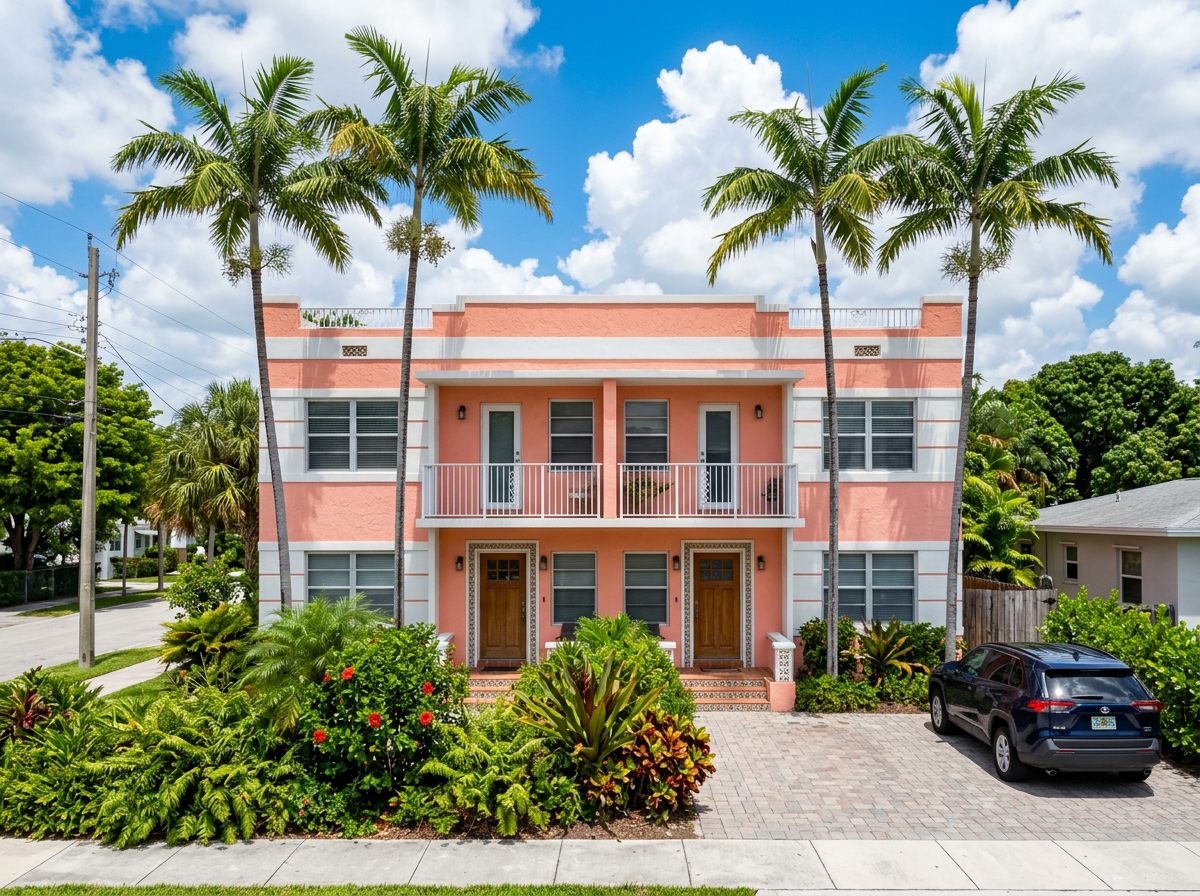
- Down payment: $800,000 × 35% = $280,000, from her salon business funds.
- DSCR loan: $800,000 − $280,000 = $520,000, funded in summer 2024.
Why did the lender question the salon money?
The lender could see the money on the business bank statements. The balance was never the problem. One more statement would only have shown the same balance again. The lender's real question was not about the balance. It was this: could the salons keep paying their own costs after $280,000 came out?

My client ran salons that made money. Their running costs were well below their sales. So I worked with her CPA on a letter about the planned withdrawal. The letter did more than say she owned a business that made money. It showed why the salons could keep paying their costs after she used business funds for the purchase. That answered the underwriter's real question. And the lender took the funds.
How did a new car loan affect her pricing?
My client had also just bought a car with a loan. That added a monthly debt and lowered her credit score. On a DSCR loan, the home's rent qualifies the loan. So her personal debt-to-income ratio did not decide whether she qualified. But her credit score still affected her rate. She paid down her credit cards. My team asked for a rapid rescore. Her score rose, and she qualified for a lower rate. The $520,000 loan funded in summer 2024.
What does this file mean for you?
- Know which account your down payment comes from: say it is in a business account. Then the question is rarely "is the money there?" It is "what happens to the business after the money leaves?"
- Give your CPA the lender's actual question: a clear question gets a letter an underwriter can use.
- Check your credit after any big purchase: on a DSCR loan the rent qualifies the loan. But your score still affects your rate.
Each loan is its own case. This file is not a promise of any outcome or rate. It shows the kind of question that decides a Miami investor file. And it shows how a clear answer gets it closed.
How do I choose a Miami mortgage broker and compare loan offers?
Loans are not hard to find in Miami. The hard part is finding the right lender for your file and your building. That is the job of a broker.
Is a broker better than a bank or direct lender?
The CFPB explains that a lender lends you money directly. A broker does not lend money. A broker helps you find lenders and loan choices. The CFPB's advice is to shop around for the best terms and fees. That holds whether you use a broker or a lender. Neither is cheaper each time. A bank or direct lender has one loan menu. If your condo fails its rules, you tend to start over somewhere else. A broker can send your file to several wholesale lenders. That helps most when one lender's rules would turn you down. That happens a lot in Miami. A building one lender rejects can be routine at another. The same goes for self-employed income and foreign assets. A simple file with a relationship discount may do fine at a bank.
How do I check a broker's license?
Each mortgage company and loan originator must be licensed. Look them up on NMLS Consumer Access. Florida's Office of Financial Regulation points buyers there to check mortgage brokers, lenders and loan originators. Check both the company and the person. My NMLS number is 1486726. iQRATE Mortgages is NMLS 1862492. Check us. And check anyone else you talk to.
How are mortgage brokers paid?
Federal rules bar a loan originator's pay from being based on your loan's terms, such as the interest rate (12 CFR 1026.36). A broker is paid by you or by the lender, not both. The amount shows on your Loan Estimate. Ask which it is. Then compare the total cost, not just the rate.
How do I compare two Loan Estimates?
A lender must give you a Loan Estimate no later than the third business day after you apply. You must get the Closing Disclosure at least three business days before closing (12 CFR 1026.19). The CFPB's Loan Estimate explainer walks through each line. It says to ask for Loan Estimates from more than one lender. Get them on the same day. Use the same loan amount, loan type and lock period. Then compare the interest rate and the APR. The APR adds many fees to the rate so you can compare. Compare points, which lower the rate. Compare lender credits, which give you money toward closing costs in trade for a higher rate. Compare the origination charges in section A, and the cash to close. On investor loans, check any prepayment penalty against how long you will keep the loan.
Here is a case, just math. One point on a $500,000 loan costs $5,000. Say it lowers your payment by $100 a month. Then it takes $5,000 ÷ $100 = 50 months to break even. If you might sell or refinance within four years, that point may not pay off.
What should I ask any Miami broker?
Ask how many lenders they can send your file to. Ask if those include non-warrantable condo, bank statement, DSCR and foreign national lenders. Ask if they will look at the building's milestone report, reserve study, budget and assessments before you commit. Ask if your payment will include real insurance quotes, taxes at your price and full condo dues from day one. Ask to see fixed, adjustable and interest-only choices side by side. Ask who you will talk to each week, and how fast they answer. And look them up on NMLS Consumer Access before you send a single document.
What mistakes do Miami buyers make?
Using the seller's tax bill is the biggest one. The payment jumps after the reset. So figure tax from your price and the address's millage. Guessing at insurance is next. The approval shrinks late in the deal. So get written wind, hazard and flood quotes early. Falling for a unit before checking the building can leave you with a loan that cannot close. Comparing rates and not total cost means paying more in fees or points. Opening new credit during the loan can lower your score and raise your price. And moving money without a paper trail causes delays and extra conditions. Keep statements for each account.
What do my clients say?
These are real 5-star reviews, quoted word for word. Each shows the reviewer's first name and last initial. They describe working with me and the iQRATE team. They are not a promise about your loan. You can read more on our reviews page.
"A few months ago we bought our first house. We were so fortunate to have David. He explained so many things that we did not understand, literally took the time to explain our options and why they would or would not work for us. He made us feel comfortable with our decision. We definitely would recommend his entire team, everyone was so wonderful and helpful." Jael O., Google
"Andrei and David were so great! They're helpful and communicated everything with me through the whole process. I am so pleased and look forward to using iqrate for my future investment properties. 10/10 Will be reccomending to friends." Kassandra A., Google
"Great professional work! Because of exceptional coordination from Andrei and the team, our escrow was closed seamlessly several days earlier. All our questions and concerns were addressed promptly. My husband and I would highly recommend this team to whoever is looking for a new mortgage or refinancing." Oksana K., Google
"We've been working with David's team for over 4 years now, they helped us get home loans and then refinance later when possible. Very responsive, always answer all our questions and concerns. When we had issues on our first home purchase with buyer, David quickly stepped in and had our back and helped us make the process as smooth as possible. Amazing team, super nice and just overall such a pleasure to work with. Thank you! Y'all are the best!" Margarita G. (Las Vegas, NV), Yelp
"We are very thankful for the excellent and extremely fast help from David Ghazaryan! As first-time home buyers we couldn't imagine a better experience. We love our new Green Valley home and recommend David Ghazaryan and his team to everyone who is looking to buy a house." Olena P., Google
"Outstanding service with the help from this team! Everything was smooth, effortless, and headache free! They answered all my questions with ease & I will recommend friends and family as well! I most definitely will continue using this company for future mortgage needs!" Ryan L., Google
"Thank you so much David and team! You made the mortgage process so easy and were very patient with me. The process was smooth and the level of communication and professionalism was extraordinary. I will definitely recommend to family and friends for their mortgage needs as well" Sophie G. (Las Vegas, NV), Yelp
What should I do before I apply for a Miami mortgage?
Most Miami files that go wrong go wrong in the first two weeks. That is before anyone signs a contract. A little work up front saves a lot of stress later. Here is the order I walk my clients through.
First, decide whether you will live in the home. Then decide how you will prove income: tax returns, bank statements or the home's rent. Those two answers set your loan type. Second, check where your loan crosses $832,750 at your down payment. If you are close, price conforming and jumbo side by side. Third, gather your papers. A W-2 worker needs two years of W-2s, 30 days of pay stubs, two months of bank statements and a photo ID. Some self-employed borrowers use full documentation. They need two years of personal and business tax returns. They also need a year-to-date profit and loss statement. A bank statement borrower needs 12 or 24 months of statements. They also need a business license or CPA letter. An investor on a DSCR loan needs the contract and a lease or rent estimate. They need LLC papers and statements for the down payment and reserves. A foreign national needs a passport, a credit letter from abroad and translated statements. A veteran needs a Certificate of Eligibility.
Then get a full pre-approval. That means your credit, income and assets are checked up front. That way your offer can compete with cash. Before you write on a condo, I check the building and ask for its papers. On a house, we get insurance and flood quotes. After you apply, the Loan Estimate comes within three business days. After the contract, the appraisal is ordered. Condo papers go to underwriting. Final approval comes when conditions are cleared, insurance is bound and the title commitment is checked. You get the Closing Disclosure at least three business days before closing. Then you sign with the title agent or attorney. The deed and mortgage are recorded with the Miami-Dade Clerk.
- Check the building before the unit: on a condo, ask for the milestone report, the SIRS, the budget, the minutes and any assessments.
- Price your real payment: look up the flood zone. Get written wind, hazard and flood quotes. Then figure taxes from your price and the address's 2026 millage.
- Run the cash flow on a rental: test the low-rent case, not just the DSCR. Check short-term rental rules before you count on nightly income.
- Freeze your credit and your cash: do not open new credit until after closing. And keep a paper trail for each deposit until then.
Ready to see which loan fits your Miami home? Apply with iQRATE or call (702) 766-3744.
The payment, tax, insurance, DSCR and closing cost examples in this guide are just math, not a quote. Loan rules vary by lender and change often. This guide is general information. It is not a loan offer, a rate quote, or legal or tax advice. All loans are subject to credit, property and underwriting approval.
Author Bio
David Ghazaryan is a mortgage broker and the owner of iQRATE Mortgages, NMLS 1862492. His personal NMLS number is 1486726. He helps buyers and investors choose and close home loans. That runs from first homes to DSCR rentals and jumbo purchases.
References
Loan limits: FHFA, 2026 conforming loan limits; FHFA, 2026 county limit file; HUD Mortgagee Letter 2025-23; HUD, 2026 FHA limits by county; VA, home loan limits.
Program rules: HUD Handbook 4000.1; HUD Mortgagee Letter 2023-05; HUD, FHA condominium approval; HUD, approved condominium search; VA, funding fee; Fannie Mae Eligibility Matrix; Fannie Mae B2-1.1-01; Fannie Mae B2-2-03; Fannie Mae B4-2.1-03; Fannie Mae LL-2026-03; Fannie Mae SEL-2026-07.
Federal consumer rules: CFPB, Regulation Z comment 3(a)-4; 12 CFR 1026.19; 12 CFR 1026.36; CFPB, lender vs. broker; CFPB, Loan Estimate explainer; CFPB, fixed vs. adjustable; CFPB, key mortgage terms; NMLS Consumer Access; Florida OFR, verify a license.
Market data: FFIEC HMDA Data Browser, 2025, Miami-Dade; MIAMI REALTORS, September 2026; MIAMI REALTORS, October 2026; Census QuickFacts; HUD FY 2026 Small Area FMRs; HUD FY 2026 FMRs.
Closing costs: Florida DOR, documentary stamp tax; section 201.031; section 199.133; rule 69O-186.003; Miami-Dade Clerk; section 28.24; section 718.116; section 720.30851.
Property tax: Miami-Dade Property Appraiser, 2026 millage; Miami-Dade Property Appraiser, homestead; Florida DOR, PT-113; Florida DOR, 2026 exemption adjustment; section 193.155; section 193.1555.
Down payment help: Florida Housing, Hometown Heroes; Florida Housing, homebuyer programs; Miami-Dade County; City of Miami.
Insurance and flood: FEMA, flood insurance and lending; FEMA Flood Map Service Center; FloodSmart; Citizens, flood requirement; section 627.351; section 627.0629; Florida DFS; section 689.302.
Condo safety: NIST, Champlain Towers South; SB 4-D; SB 154; HB 1021; HB 913; section 553.899; section 718.112; section 718.503; Miami-Dade recertification; DBPR condo inspections.
Rentals and foreign buyers: section 509.032; section 509.013; DBPR lodging; section 212.03; Florida DOR, sales tax; Miami-Dade tourist taxes; City of Miami short-term rentals; Miami Beach short-term rentals; IRS, FIRPTA; IRS, FIRPTA exceptions; IRS, ITIN; section 692.204.