
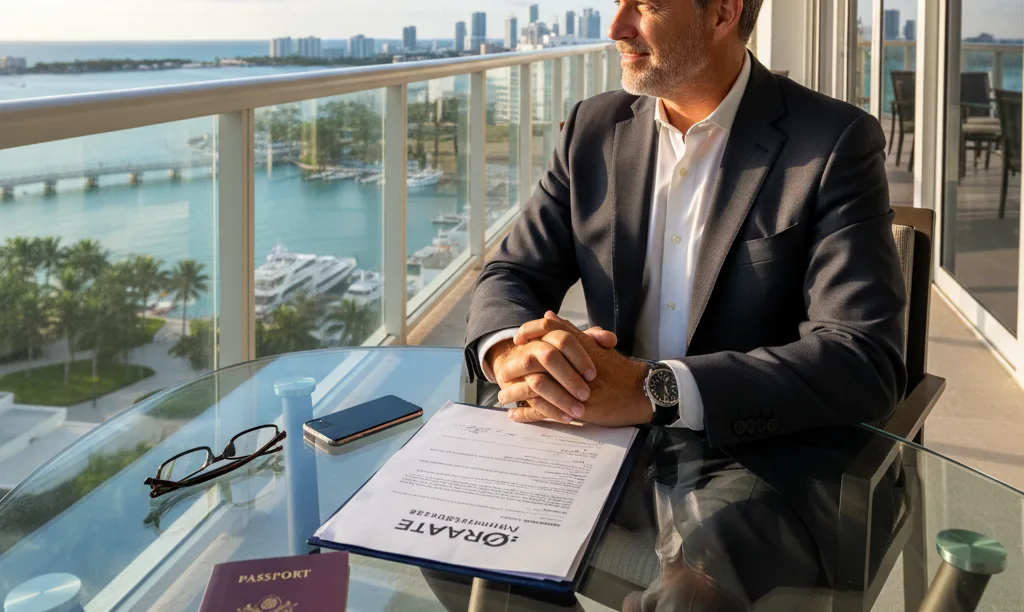

Benefits of a Foreign National Buying a Miami Rental in an LLC?
Purchasing a Florida investment property as a foreign national presents a unique set of opportunities and challenges. While you can buy property under your personal name, forming a Limited Liability Company (LLC) offers strategic advantages that sophisticated investors leverage. For those eyeing the bustling rental markets of Miami or Fort Lauderdale, an LLC structure provides a crucial layer of protection and flexibility.
Here are the primary benefits:
- Asset Protection: This is the most significant advantage. By holding the property within an LLC, you separate your personal assets (like your primary residence in your home country, bank accounts, and other investments) from the rental property. If a lawsuit were to arise related to the property—for instance, a tenant dispute or an accident—the claim would be against the LLC's assets, not your personal wealth. This corporate veil is essential for risk management.
- Privacy: When you buy property as an individual, your name is on the public record as the owner. An LLC allows you to hold the title in the company's name, providing a degree of anonymity. While the LLC's managing members may still be public, it creates a buffer that many international investors prefer.
- Ease of Ownership Transfer: Selling shares of an LLC can be simpler and more private than transferring a real estate deed. You can bring on partners or transfer ownership to heirs by modifying the LLC's operating agreement, a process that can sometimes be more streamlined and may have different tax implications than a traditional property sale.
- Perceived Professionalism: Operating through an LLC presents a more professional image to tenants, property managers, and lenders. It signals that you are a serious investor managing a business, which can be beneficial when securing financing or negotiating contracts.
Specific Documents for a Foreign-Owned LLC Mortgage?
Lenders who specialize in foreign national loans have a structured documentation process designed to verify both the individual investor and the business entity. Unlike a traditional mortgage, this process involves two sets of paperwork. Expect to provide comprehensive documentation to prove your identity, financial stability, and the legitimacy of your LLC.

Documents for the Foreign National (Individual Guarantor)
- Valid Passport: A clear, unexpired copy of your passport from your country of citizenship.
- Valid U.S. Visa: Typically a B-1 (Business Visitor) or B-2 (Tourist Visitor) visa is acceptable. Some lenders do not require a visa if you are from a country participating in the Visa Waiver Program.
- Proof of Foreign Residence: A utility bill or bank statement showing your name and address in your home country.
- International Credit Report: Some lenders may request a credit report from your country of residence, though many foreign national loan programs do not require it.
- Bank Statements: Three to twelve months of personal or business bank statements to verify funds for the down payment, closing costs, and required reserves. (The data, information, or policy mentioned here may vary over time.)
Documents for the Florida LLC (The Borrower)
- Articles of Organization: The official document filed with the Florida Division of Corporations (Sunbiz) that created your LLC.
- Operating Agreement: This internal document outlines the LLC's ownership structure, member responsibilities, and operational rules. It is critical, especially if there are multiple partners.
- Certificate of Good Standing: A document from the state of Florida confirming your LLC is registered and compliant with state requirements.
- Employer Identification Number (EIN): Your LLC's federal tax ID number, obtained from the IRS.
How Do Lenders Verify Income and Assets from Another Country?
This is a common hurdle for foreign investors. U.S. lenders cannot simply pull a domestic credit report or verify a W-2. Instead, they rely on alternative methods to confirm your financial capacity. For investor loans, the focus is often less on personal income and more on the property's potential to generate revenue.
The most common approach is a Debt Service Coverage Ratio (DSCR) loan. A DSCR loan qualifies you based on the investment property's cash flow, not your personal salary. The calculation is straightforward:
DSCR = Gross Monthly Rental Income / Total Monthly Housing Expense (PITI)
Lenders typically look for a DSCR of 1.25 or higher. (The data, information, or policy mentioned here may vary over time.) For example, if you're buying a duplex in West Palm Beach with a projected monthly rent of $5,000 and the total monthly mortgage payment (including principal, interest, taxes, and insurance) is $4,000, your DSCR would be 1.25 ($5,000 / $4,000). This demonstrates the property can sustain itself, making personal income verification unnecessary.
For asset verification, lenders will require:
- Bank Statements: Statements from your foreign financial institution are acceptable. They must clearly show your name and the account balance.
- Certified Translations: If your bank statements are not in English, you will need to provide certified translations.
- Accountant Letter: A letter from your chartered accountant in your home country can be used to verify your income and overall financial health, though this is less common for DSCR loans.
What is FIRPTA and How Does It Impact My Real Estate Investment?
FIRPTA, the Foreign Investment in Real Property Tax Act of 1980, is a critical piece of U.S. tax law that every foreign investor must understand. It is not an additional tax but rather a withholding mechanism to ensure that foreign sellers pay U.S. capital gains taxes upon the sale of their property.

Here’s how it works:
- Withholding at Sale: When a foreign national or a foreign-owned LLC sells a U.S. real estate asset, the buyer is legally required to withhold 15% of the gross sales price and remit it to the IRS.
- Example: If you sell your Miami rental property for $800,000, the buyer must send $120,000 (15% of $800,000) to the IRS within 20 days of closing.
- Reclaiming the Withholding: This withheld amount is a pre-payment of your estimated capital gains tax. After the sale, you must file a U.S. tax return to report the sale and calculate the actual tax owed. If the actual tax is less than the amount withheld, you will receive a refund from the IRS.
- Applying for a Withholding Certificate: To avoid having the full 15% withheld, you can apply for a withholding certificate from the IRS before the closing. This certificate can reduce or eliminate the withholding amount if you can prove that the final tax liability will be less than the 15% withholding.
Properly planning for FIRPTA with a qualified tax advisor is essential to avoid surprises and manage your cash flow when you eventually decide to sell.
Are DSCR Loan Interest Rates Higher for Foreign Investor LLCs?
Yes, you can generally expect interest rates for foreign national investor loans to be slightly higher than those for domestic borrowers. Lenders price for perceived risk, and several factors contribute to this:
- Cross-Border Complexity: Underwriting a foreign borrower and an LLC involves more complex documentation and verification.
- Recourse Difficulty: In the event of a default, it is more difficult and costly for a U.S. lender to pursue legal action against a borrower residing in another country.
- Lack of U.S. Credit History: Without a FICO score, lenders rely on other metrics like down payment and asset reserves, which often translates to a higher interest rate.
As a baseline, a foreign national investor might expect an interest rate that is 0.5% to 1.5% higher than a comparable domestic investor. (The data, information, or policy mentioned here may vary over time.) A larger down payment (typically 30-40%) and significant liquid reserves can help you secure more favorable terms.
Can I Get a Loan If My LLC Has Multiple Foreign Partners?
Yes, obtaining a loan for an LLC with multiple foreign partners is possible, but it increases the lender's underwriting scrutiny. The lender will need to vet every significant owner of the LLC.
- Ownership Threshold: Any partner who owns 25% or more of the LLC will typically be required to act as a personal guarantor on the loan. (The data, information, or policy mentioned here may vary over time.)
- Full Documentation for Each Partner: Each guaranteeing partner must provide the full set of personal documents, including their passport, visa, and financial statements.
- Operating Agreement Clarity: The LLC's operating agreement becomes paramount. It must clearly define the ownership percentages, roles, and responsibilities of each partner. Lenders will review it carefully to ensure the entity has a clear decision-making structure.
For example, if two partners from Brazil form an LLC to buy a rental property in Fort Lauderdale, both will need to be part of the loan application, provide their individual documents, and sign as guarantors.
Do I Need a United States Bank Account to Get an Investor Loan?
Yes, having a U.S. bank account is almost always a non-negotiable requirement for obtaining a foreign national investor loan. Lenders require it for several practical reasons:
- Loan Servicing: Mortgage payments will be automatically debited from this account.
- Disbursing Funds: The loan proceeds are deposited into a U.S. account at closing.
- Holding Reserves: Lenders require you to have several months of mortgage payments (reserves) held in a U.S. account.
- Operational Ease: It simplifies managing the property. You can easily receive rent payments and pay for expenses like property taxes, insurance, and maintenance from the same account.
Opening a U.S. bank account usually requires an in-person visit with your passport and LLC's EIN.
How Does This Process Differ From Buying as an Individual?
While the goal is the same—acquiring a U.S. investment property—the process of buying within an LLC is structurally different from buying as an individual foreign national.
Buying in an LLC
- Borrower: The LLC is the legal borrower.
- Title: The property title is held in the name of the LLC.
- Liability: Personal assets are protected from business-related lawsuits.
- Documentation: Requires both personal (guarantor) and corporate (LLC) documents.
- Complexity: The process is more complex, involving entity formation and adherence to corporate formalities.
Buying as an Individual
- Borrower: You are the legal borrower.
- Title: The property title is held in your personal name.
- Liability: Your personal assets are exposed to any liabilities related to the property.
- Documentation: Requires only your personal financial and identity documents.
- Complexity: The process is more straightforward, with fewer legal and administrative steps.
If you're ready to explore financing options for your Florida investment property, Apply now to get a clear assessment from a specialist in foreign national loans.
Author Bio
David Ghazaryan is the expert mortgage strategist and founder behind iQRATE Mortgages. With a mission to fund home loans that traditional banks won't touch, David specializes in helping clients with unique financial situations, including those recovering from foreclosure or bankruptcy. He expertly crafts smart, strategic, and stress-free mortgages by leveraging a vast network of over 100 lenders to secure competitive rates for investors and homebuyers alike. Praised for exceptional customer service, David has helped hundreds of families with a 97% satisfaction rate, guiding them to the mortgage they deserve.
References









