


What is a VA Loan Buyout in a Divorce or Separation Scenario?
A VA loan buyout is a specialized type of refinance designed for military service members and veterans who are legally separating or divorcing. When a couple who jointly owns a home financed with a VA loan decides to part ways, a buyout allows one veteran to purchase the other's share of the home's equity. The result is a new VA loan in the retaining veteran's name only.
This financial maneuver is critical for untangling shared assets. It formally removes the departing spouse from both the mortgage obligation and the property title, preventing future credit issues or legal disputes over the property. The primary goal is to allow one veteran to retain the family home while providing the other with their fair share of the accumulated equity. This is achieved by refinancing the existing mortgage for a higher amount that covers the original loan balance plus the equity owed to the ex-spouse.
The entire process is governed by VA guidelines and must be explicitly ordered by a court through a divorce decree or separation agreement. This legal backing is non-negotiable and ensures the transaction is executed according to the terms agreed upon during the legal proceedings.
How Is This Different From a Standard VA Cash-Out Refinance in Dallas?
While a VA loan buyout is technically a form of cash-out refinance, it operates under a unique set of rules that distinguish it from a standard VA cash-out refinance. Understanding this difference is crucial for veterans in communities like Dallas, Texas, where property values can create significant equity.
A standard VA cash-out refinance allows a qualified veteran to refinance their current mortgage for a higher amount and take the difference in cash. The Department of Veterans Affairs typically allows veterans to borrow up to 90% of their home's appraised value for this purpose. The cash can be used for any reason: home improvements, debt consolidation, or other investments.
A VA loan buyout refinance for a divorce, however, has a distinct purpose and advantage. The funds are specifically earmarked to pay an ex-spouse their share of home equity. Because of this legally mandated purpose, the VA allows the veteran retaining the home to potentially refinance up to 100% of the home's appraised value. This higher loan-to-value (LTV) ratio is a significant benefit, as it may eliminate the need for the veteran to use other assets to complete the buyout.
For example, imagine a veteran in Dallas whose home is appraised at $500,000 with a remaining mortgage of $300,000.
- With a standard cash-out refinance, they could borrow up to 90%, or $450,000. After paying off the $300,000 mortgage, they would have $150,000 in cash.
- With a divorce buyout, if the court orders a $100,000 equity payment to the ex-spouse, the veteran can refinance for $400,000 ($300,000 mortgage + $100,000 buyout). If this amount is within the 100% LTV limit, it can be fully financed without out-of-pocket costs for the equity portion.
What Are the Eligibility Rules for the Veteran Retaining the Home?
To successfully secure a VA loan buyout, the veteran who wishes to keep the home must meet several specific requirements. Lenders will scrutinize the application to ensure it aligns with both VA and internal underwriting standards.
- VA Loan Eligibility: The veteran retaining the property must have sufficient VA loan entitlement. They must also be the one living in the home, as VA loans require the property to be the borrower's primary residence.
- Credit and Income Qualification: The veteran must qualify for the new, larger loan amount on their own. The lender will evaluate their credit score, debt-to-income (DTI) ratio, and residual income based solely on their financial profile. The ex-spouse's income is no longer considered. (The data, information, or policy mentioned here may vary over time.)
- Court Order: There must be a legally binding divorce decree or separation agreement signed by a judge. This document must explicitly state that one spouse is awarded the home and is required to buy out the other's equity. It should also specify the exact dollar amount of the equity to be paid.
- Occupancy: The veteran refinancing the loan must certify that they will personally occupy the property as their primary residence after the refinance is complete.
How Is the Buyout Equity Amount Calculated and Paid to the Ex-Spouse?
Calculating the buyout amount is a straightforward mathematical process that is finalized in the divorce decree. The funds are then disbursed to the departing spouse at the loan closing.
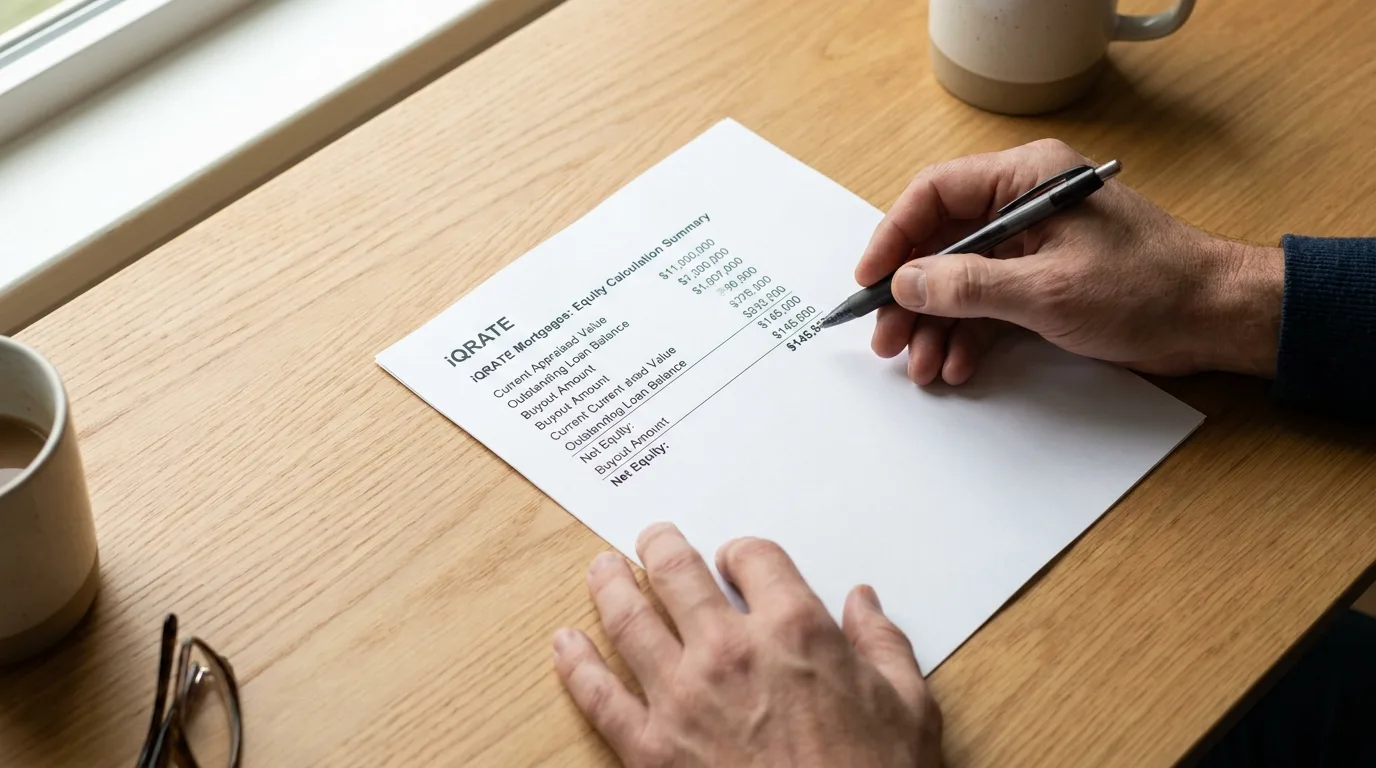
Here’s a step-by-step breakdown:
- Home Appraisal: The first step is to get a new, independent appraisal of the property to determine its current fair market value. This is a mandatory step for the refinance.
- Determine Total Equity: The total equity is calculated by subtracting the outstanding mortgage balance from the appraised value.
- Divide the Equity: The divorce decree will specify how the equity is to be divided. In most cases, it is split 50/50, but the court can order a different distribution.
- Calculate the New Loan Amount: The new loan amount will be the sum of the original mortgage balance, the equity buyout payment due to the ex-spouse, and any applicable closing costs and the VA funding fee.
Example Scenario in Austin:
- Appraised Home Value in Austin:
$600,000 - Remaining Mortgage Balance:
$350,000 - Total Home Equity:
$600,000 - $350,000 = $250,000 - Court-Ordered Equity Split (50%):
$125,000to be paid to the departing spouse. - New Loan Amount Calculation:
- Original Mortgage:
$350,000 - Equity Payout:
$125,000 - Estimated Closing Costs/Funding Fee:
$10,000(The data, information, or policy mentioned here may vary over time.) - Total New VA Loan:
$485,000
- Original Mortgage:
At closing, the new $485,000 loan pays off the old $350,000 mortgage, and a check for $125,000 is issued directly to the ex-spouse. The remaining $10,000 covers the transaction costs.
Can the Departing Veteran Have Their VA Entitlement Restored?
Yes, but the process depends on the status of the veteran retaining the home. Restoring the departing veteran's VA entitlement is a major concern, as it allows them to use their VA loan benefit to purchase another home in the future. There are two primary scenarios:
- Veteran-to-Veteran Transfer: If the spouse retaining the home is also an eligible veteran with their own VA entitlement, they can substitute their entitlement for the one used on the original loan. This is the cleanest method. Once the refinance is complete, the departing veteran can apply for a full restoration of their entitlement by providing the VA with the closing documents from the refinance.
- Loan is Paid in Full: If the retaining spouse is not a veteran or chooses to refinance into a non-VA loan (like a conventional or FHA loan), the departing veteran's entitlement remains tied to the property. Their entitlement can only be restored once the original VA loan is paid off in full. This is a critical point of negotiation during the divorce, as it can impact the departing veteran's ability to buy another home.
What Court Documents Are Required for the Loan Application in Austin?
Lenders in Austin and across Texas require precise legal documentation to approve a VA loan buyout. The divorce decree is the cornerstone of the application. Simply agreeing to the buyout isn't enough; it must be legally documented.
The key document is the final, signed, and court-filed divorce decree or separation agreement. Lenders will review this document for specific language, including:
- A clear statement awarding the property to the retaining spouse.
- An explicit order for the retaining spouse to refinance the mortgage to remove the departing spouse's name and liability.
- The exact dollar amount of the equity to be paid to the departing spouse.
Ambiguous or missing language can halt the loan process. It is vital to work with a family law attorney who understands these mortgage requirements to ensure the decree is worded correctly.
What Happens if the Home Has More Equity Than the VA Loan Limit?
The VA loan limit does not cap a home's value but rather the amount the VA will guarantee for a lender. In most of the U.S., veterans with full entitlement have no VA loan limit. However, if a veteran has an existing VA loan or has defaulted on one, their entitlement might be reduced.
In a buyout scenario, the new loan amount must be covered by the veteran's available entitlement. If the new loan (original balance + equity payout) exceeds what the veteran's entitlement can cover, the lender may require a down payment. This situation is less common now due to the elimination of loan limits for most veterans, but it can still arise. The veteran would need to bring cash to closing to cover the difference between the maximum loan amount the lender will approve and the total amount needed for the buyout.
Can a New, Non-Veteran Spouse Be Added to the Refinanced Loan?
Yes, a veteran can add a new, non-veteran spouse to the refinanced loan. This is a common scenario if the veteran has remarried. When a non-veteran spouse is a co-borrower, the lender will consider their income and credit to help qualify for the loan. This can be particularly helpful if the veteran's income alone is not sufficient to qualify for the larger refinanced mortgage.
When the co-borrower is the veteran's legal spouse, the VA's guarantee is calculated on the total loan amount, providing the same level of security to the lender as a loan made solely to the veteran. While the VA does not require a down payment in this scenario, a specific lender may still require one based on their internal underwriting policies and the overall financial strength of the borrowers. (The data, information, or policy mentioned here may vary over time.) Navigating a VA loan buyout during a divorce requires expert guidance and careful financial planning. To explore your specific options for retaining your home in Texas with a specialist who understands VA guidelines and divorce-related refinances, take the next step.
If you are ready to take the first step toward securing your home and financial future, Apply now for a no-pressure consultation to understand your options.
Author Bio
David Ghazaryan is the expert mortgage strategist and founder behind iQRATE Mortgages. With a mission to fund home loans that traditional banks won't touch, David specializes in helping clients with unique financial situations, including those recovering from foreclosure or bankruptcy. He expertly crafts smart, strategic, and stress-free mortgages by leveraging a vast network of over 100 lenders to secure competitive rates for investors and homebuyers alike. Praised for exceptional customer service, David has helped hundreds of families with a 97% satisfaction rate, guiding them to the mortgage they deserve.
References
CFPB - What happens to the mortgage when a spouse dies or gets divorced?









