


What is Payment Shock and Why Do Lenders Care?
'Payment shock' is a term mortgage underwriters use to describe a significant increase between your current housing payment (rent) and your proposed new monthly mortgage payment, which includes principal, interest, taxes, and insurance (PITI). It’s not just about your debt-to-income (DTI) ratio; it’s about your demonstrated ability to manage a much larger financial obligation month after month.
Imagine you’ve been comfortably paying $2,100 in rent for a two-bedroom apartment in Fresno. You get pre-approved for a mortgage and find a home you love, but the total monthly payment is calculated to be $4,500. While your income might technically support this on paper according to DTI rules, an underwriter sees a 114% increase in your housing expense. This jump is the 'payment shock'.
Lenders care because it’s a primary indicator of future default risk. A solid income and credit score are great, but they don't prove you have the discipline and cash flow management skills to handle a payment that’s more than double your current one. Underwriters ask a simple question: 'If this applicant has never managed a $4,500 housing payment before, what evidence do we have that they can start now without financial distress?' A high payment shock is a red flag that requires a closer, manual review of your finances.
How a Payment Increase Triggers Denial in Sacramento
There isn't a single, universal percentage that automatically triggers a denial. However, in competitive and high-cost areas like Sacramento, underwriters are particularly sensitive. Generally, a payment shock exceeding 150% to 200% will almost certainly move your loan application from an automated approval to a manual underwriting queue. (The data, information, or policy mentioned here may vary over time.)
Let's break down a realistic Sacramento scenario:
- Applicant's Situation: A couple rents a home in the Pocket area of Sacramento for $2,300 per month. They have good jobs, a 740 credit score, and have saved a 5% down payment.
- Proposed Mortgage: They find a home they want to buy. After calculating PITI, the new monthly payment comes to $5,200.
- The Calculation: ($5,200 New PITI - $2,300 Old Rent) / $2,300 Old Rent = 126% Payment Shock.

While 126% isn't an automatic 'no', it’s high enough to make an underwriter pause. They will immediately look for compensating factors. If the couple has minimal savings beyond their down payment and closing costs, has other significant debts (like two large car payments), or a history of inconsistent savings, the lender may issue a denial. The reasoning is that the couple has not demonstrated a history of managing the $2,900 difference each month, and their financial cushion is too thin to absorb that shock.
Can You Get Approved in Fresno With High Payment Shock?
Yes, you can absolutely get approved for a mortgage in Fresno even with significant payment shock, but you cannot rely on your income and credit score alone. You must proactively provide evidence that you are prepared for the financial adjustment. This is where compensating factors become critical.
An underwriter facing a file with high payment shock is looking for overwhelming proof of financial stability. Here’s what can turn a potential denial into an approval:
- Significant Cash Reserves: This is the most powerful tool. If your new PITI is $4,000, having six to twelve months of PITI ($24,000 to $48,000) in your bank account after paying your down payment and closing costs is a massive compensating factor. (The data, information, or policy mentioned here may vary over time.) It shows you have a safety net.
- Verified Savings History: Demonstrating that you consistently save an amount equal to or greater than the payment shock is crucial. If the difference between your rent and new PITI is $1,800, bank statements showing you've saved $2,000 every month for the last 12-24 months is concrete proof you can handle the new budget.
- Low Debt-to-Income Ratio: If your DTI is very low, say 25% with the new mortgage payment, it gives the underwriter confidence that you have ample disposable income to absorb the higher housing cost.
What Documents Can I Provide to Overcome a Payment Shock Denial?
If you anticipate payment shock being an issue, or if you've already been flagged for it, being proactive with your documentation is key. Don't wait for the underwriter to ask for more information. Provide a comprehensive package upfront.
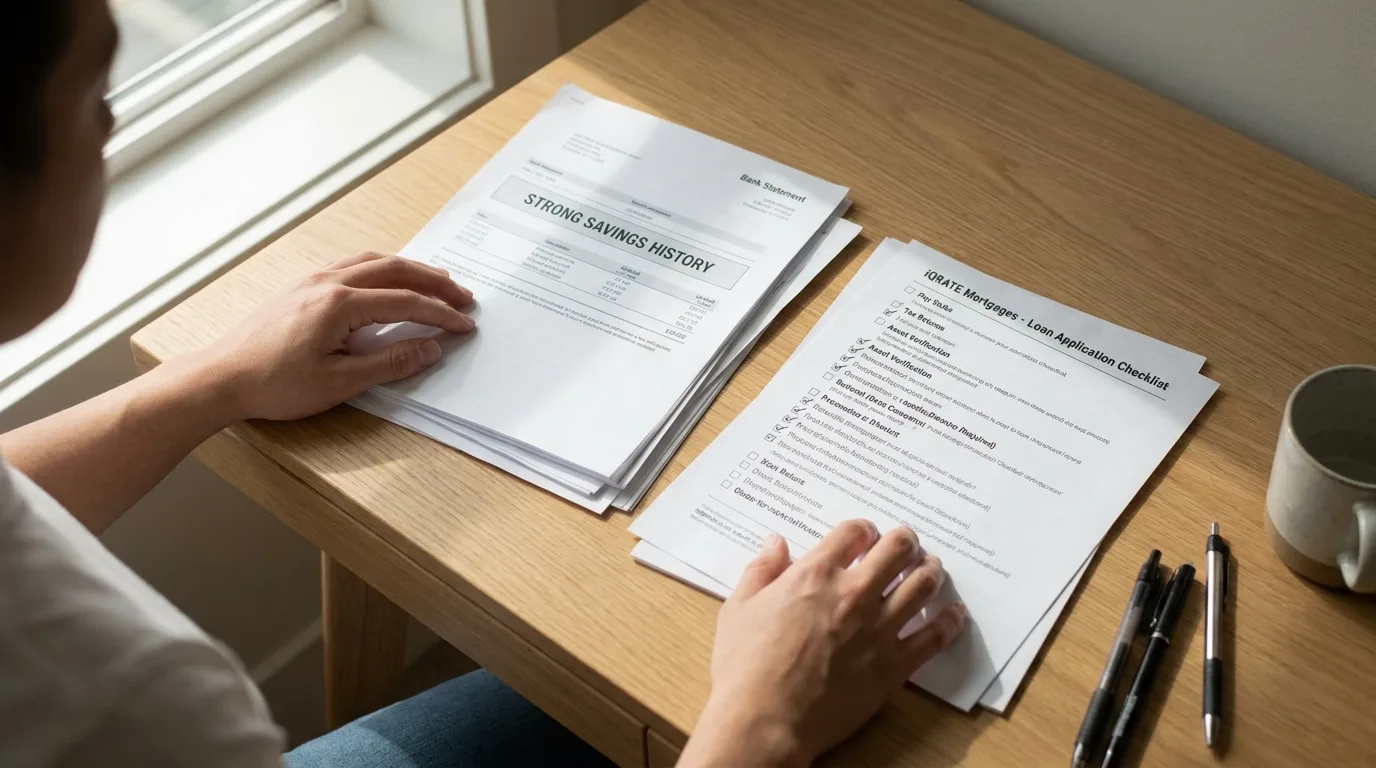
Key Documents to Gather:
- Twelve Months of Bank Statements: Provide statements for all checking and savings accounts. The goal is to show a clear pattern of regular deposits and an increasing balance over time. Highlight the monthly transfers to your savings account.
- Proof of Rent Payments: Supply 12 months of canceled rent checks or a printout from your bank's online bill pay. This establishes your baseline housing payment history.
- A Detailed Letter of Explanation (LOX): This is your opportunity to tell your story. Don't just state the obvious. Explain how you've prepared. For example: 'Over the past 18 months, my partner and I have been living on a budget as if our rent was already $4,000. We have successfully saved the $1,900 difference each month, as evidenced by our attached savings account statements, to prepare for homeownership.'
- Verification of Assets: If you have assets in retirement accounts (like a 401(k)) or brokerage accounts, provide the most recent statements. Even if you don't plan to use these funds, they demonstrate a broader financial picture of stability.
Federal Housing Administration and Conventional Loans View Payment Shock Differently
The way payment shock is treated often depends on the loan type and the automated underwriting system (AUS) being used.
Conventional Loans (Fannie Mae & Freddie Mac)
For conventional loans, the AUS (Fannie Mae's 'Desktop Underwriter' or Freddie Mac's 'Loan Product Advisor') is the first line of defense. If you get an 'Approve/Eligible' finding from the AUS, payment shock is often a non-issue. However, if your file has layers of risk—such as a high DTI ratio combined with a low down payment—the AUS might refer the loan for a manual underwrite. In a manual review, payment shock becomes a central point of analysis.
FHA Loans
The Federal Housing Administration (FHA) guidelines are often more explicit about scrutinizing payment shock, especially during a manual underwrite. An underwriter may consider a housing expense increase of 200% or more with a corresponding DTI ratio over 40% as a significant risk that requires strong compensating factors, like substantial cash reserves, to approve. (The data, information, or policy mentioned here may vary over time.)
Essentially, FHA's mission is to help borrowers with lower credit scores and smaller down payments, but this is balanced by ensuring the borrower has a high probability of success. A massive payment shock introduces too much uncertainty without strong mitigating evidence.
How Building a Savings History Helps Your Mortgage Application
Your savings history is the single most compelling piece of evidence to counteract payment shock. Lenders want to see a pattern of behavior, not just a snapshot in time. A large, recent deposit into your account from a gift is helpful for a down payment, but it does nothing to prove your monthly budgeting discipline.
Let’s use an example to illustrate the power of a savings history:
- Payment Shock: Your new mortgage in Sacramento is $2,000 more per month than your current rent.
- Scenario A (Weak): You have $50,000 in your savings account. $30,000 of it was deposited two months ago from a family gift. Your balance for the 10 months prior was mostly flat.
- Scenario B (Strong): You have $50,000 in your savings account. Bank statements for the last 24 months show that you have automatically transferred $2,200 from your checking to your savings on the 1st of every month, without fail.
Scenario B is infinitely stronger. It tells the underwriter that you have already been 'practicing' your new mortgage payment. You have proven, through consistent action over a long period, that you can live without that $2,200 each month. It removes the lender's doubt and directly addresses the core risk of payment shock.
Are There Specific Home Loans for First Time Buyers That Ignore Payment Shock?
No standard first-time homebuyer program—like those offered through FHA, Fannie Mae, or Freddie Mac—formally 'ignores' payment shock. It is a fundamental component of risk assessment, especially in a manual underwrite.
However, some loan types and situations can minimize its impact:
- Strong AUS Approval: As mentioned, a strong 'Approve/Eligible' finding from the automated system on a conventional loan can often override underwriter concerns about payment shock.
- Large Down Payment: Putting 20% or more down significantly reduces the lender's risk. (The data, information, or policy mentioned here may vary over time.) This creates instant equity and lowers your loan-to-value (LTV) ratio, which can act as a powerful compensating factor against payment shock.
- Non-QM or Portfolio Loans: These loans are not bound by FHA or conventional guidelines. A local bank or credit union holding the loan in their own portfolio might have more flexible internal rules, potentially overlooking payment shock if the borrower has a unique but strong financial profile (e.g., a self-employed business owner with massive assets but fluctuating income).
Should I Find a Cheaper House in Sacramento to Avoid This Issue?
This is a practical and often wise strategy. The most direct way to eliminate payment shock is to reduce the 'shock' itself. Looking for a less expensive home in Sacramento or surrounding areas is a guaranteed way to lower your proposed PITI and bring it closer to your current rent.
This approach has several benefits:
- Smoother Underwriting: It makes your loan application far less risky and more likely to sail through the automated underwriting system.
- Less Financial Stress: You’ll have more breathing room in your monthly budget for savings, emergencies, and other life expenses.
- Stronger Purchase Offer: In a competitive market, having a rock-solid, straightforward loan approval can be more attractive to a seller than a higher offer with questionable financing.
However, it's not the only option. If you are set on a specific home and can prove your financial readiness through the methods described above—deep reserves and a stellar savings history—you can still overcome the payment shock hurdle. The key is to assess your financial picture honestly and choose the path that aligns with both your homeownership goals and your long-term financial health.
Navigating payment shock in California requires a clear strategy. By understanding your complete financial picture, you can proactively address underwriter concerns. If you're ready to see how your preparation aligns with your homeownership goals, you can Apply now to get a clear, personalized assessment.
Author Bio
David Ghazaryan is the expert mortgage strategist and founder behind iQRATE Mortgages. With a mission to fund home loans that traditional banks won't touch, David specializes in helping clients with unique financial situations, including those recovering from foreclosure or bankruptcy. He expertly crafts smart, strategic, and stress-free mortgages by leveraging a vast network of over 100 lenders to secure competitive rates for investors and homebuyers alike. Praised for exceptional customer service, David has helped hundreds of families with a 97% satisfaction rate, guiding them to the mortgage they deserve.
References
CFPB - What is a debt-to-income ratio?









